

From rise to necessity, what drives the popularity of AI dev tools?
Not long ago, AI development tools were useful only for experimentation. Today, that perception has changed. As the software delivery timeline shortens and productivity gains stagnate, AI tools are becoming a structural requirement rather than a directional upgrade.
For modern businesses, this shift signals a transition from headcount-driven productivity to leverage-driven productivity. AI development plugins allow dev teams to reduce cycle times without proportionally increasing the hiring or cloud costs. They enable tech organizations scale output, improve quality, and manage complexity more effectively.
What are AI plugins?
AI plugins are software extensions that integrate AI capabilities into software products, enhancing functionality through intelligent automation, prediction, and data analysis. Integrating these plugins into the development process allows developers to embed pre-built AI services quickly via SDKs or APIs.
It reduces complex software development cycles and speeds time-to-market while maintaining scalability, security, and alignment with existing standards, which traditional methods lack.
Where does the current software development lifecycle (SDLC) lag?
- Requirements are often incomplete or change later in the cycle.
- Developers spend a significant amount of time debugging avoidable issues.
- Design decisions lack early validation, increasing downstream risk.
- Code reviews are slow and heavily dependent on senior engineers.
- Technical debt accumulates faster than it’s resolved.
- Legacy code slows delivery and complicates modernization efforts.
- Testing happens late, causing defects to surface close to release.
- Maintenance work consumes capacity that could be used for new software dev features.
- Release timelines become unpredictable.
- Productivity gains rely heavily on adding headcount or additional tools.
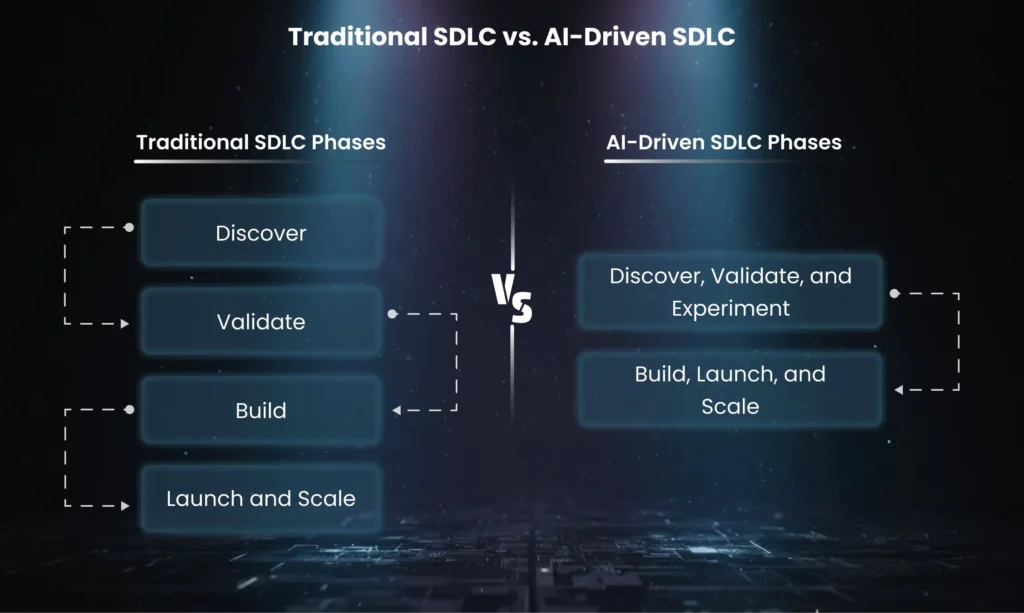
How are AI plugins revolutionizing the future of development?
First, a quick clarification: AI-driven development solutions aren’t replacing developers. What they change is how development gets done day-to-day.
With AI tools embedded into CI pipelines, IDEs, and code review workflows, dev teams spend less time on repetitive fixing and more time on decisions that move products forward. Over time, this has positively impacted delivery costs, speed, and quality.
What’s changing now in AI-powered software development?
1. Development process becomes feedback-first
- AI helps developers see issues as they write code, not days later in review.
- Teams fix problems immediately rather than resolve them later.
- Developers get instant feedback, allowing quicker corrections.
2. Debugging becomes a continuous process
- AI predicts and blocks vulnerabilities across full pipelines.
- Teams spot potential issues before they turn into production problems.
- Developers spend less time fixing issues and more time on other important tasks.
3. Systems improvement with routine modernization
- Developers refactor small pieces of code rather than writing larger code.
- Modernization becomes part of the day-to-day development process.
- Plugins suggest microservice splits and cloud shifts during edits.
How will AI change software development in the future?
1. Autonomous task management for development teams
AI will predict the optimal team configurations and dynamically assign tasks based on skills and workload. It means:
- Reduced bottlenecks
- Optimized resource allocations
- Effective team scaling without increasing headcount.
2. Full-spectrum AI-driven code generation and maintenance
AI will write entire applications and refactor legacy code based on high-level objectives given by developers, resulting in:
- Accelerated delivery time
- Minimized human error
- Reduced maintenance costs through automated repetitive coding
Leading AI-powered development tools for each stage of the SDLC
The AI plugins revolutionizing development workflows above? They’re powered by specialized AI development tools, integrated across the full SDLC to eliminate repetition, deliver insights, and minimize human errors from planning to production.
There are several types of AI dev tools, of which the following six are well-known for supporting various stages of the SDLC:
| Tools | Primary Function | Best for | Business Value | Key Considerations |
| ChatGPT/OpenAI | AI reasoning, automation, and code intelligence | Org-wide development acceleration | Speeds up development, debugging, documentation, and internal tooling | Requires governance and secure usage policies |
| GitHub Copilot | AI code generation and assistance | Developer productivity at scale | Reduces coding time and accelerates feature delivery | Must be paired with strong review practices |
| Linear | AI-assisted project planning and tracking | Agile project and engineering teams | Improves delivery predictability and execution focus | Optimized mainly for software teams |
| Tabnine | AI code completion and test generation | Teams focused on code quality | Increases development speed while supporting test coverage | Less impact on poorly structured codebases |
| Graphite Agent | Automated AI-powered code review | High-velocity pull request workflows | Reduces review bottlenecks and improves code quality | Human review is still required |
| Jenkins with AI plugins | Intelligent CI/CD automation | DevOps and platform engineering teams | Improves deployment reliability and pipeline efficiency | Requires mature CI/CD foundations |
These tools don’t just exist on paper. We at Unified Infotech deploy them daily across client SDLCs, accelerating delivery from AI transcription apps to blockchain platforms. Let’s discuss one of our real results next.
Leveraging AI-powered development plugins in the Unified Infotech way
Recently, our team of expert software developers at Unified Infotech leveraged AI tools to help one of our clients. A distinguished marble furniture manufacturing company approached us to optimize their material planning process. They needed a system that could accurately calculate the amount of marble slabs required for manufacturing custom furniture.