
The world is going digital at an unprecedented pace, and the internet has brought about a change in all aspects of our lives. The way people plan travel and book hotels has changed.
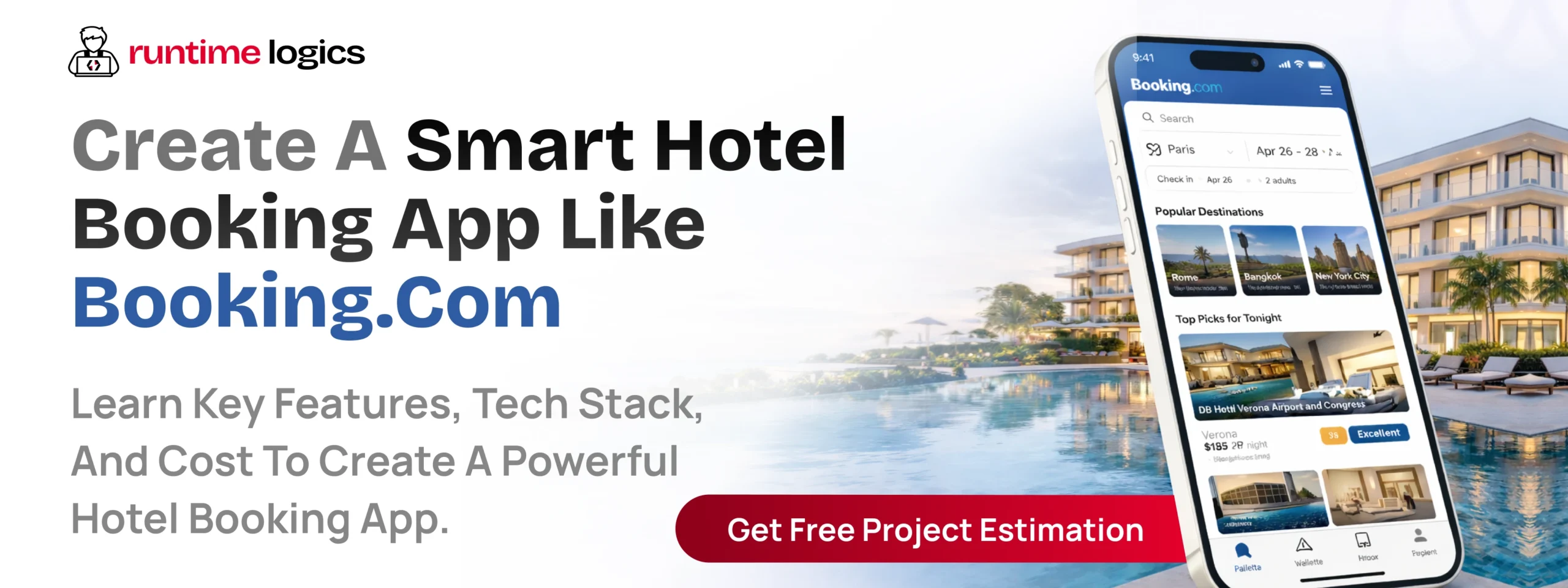
Booking.com has created a benchmark as a hotel booking app, and entrepreneurs are now looking to develop online hotel reservation systems like Booking.com. The top factors that popularize Booking.com are its user-friendly design, global reach, and booking process. The Google Play Store has recorded 100 million downloads of the app.
How Booking.com makes money
Booking.com primarily monetizes the platform by levying a commission on accommodation providers. They may have listed hotel rooms or vacation stays on the website for short-term stays. Commission rates typically fall in the range of 10-25%.
The agency model and the merchant model are the two main business structures at Booking.com.
When working on the agency model, Booking.com is a mere intermediary. The customer directly pays for the property. Booking.com then sends a monthly invoice to the accommodation provider to collect its commission.
However, when Booking.com operates on the merchant model, it directly collects payments from guests over its website when they book a property. They subtract their commission from the paid amount and transfer the rest over to the provider. From 2024 onwards, the merchant model has been the primary source of revenue for Booking.com and has brought in 60% of their revenue. The Preferable Partner Program, paid advertising, and ancillary sales are the other sources of revenue at Booking.com.
Current market value of Booking.com
Booking.com’s market value is massive, and in 2024, it stood at over $165 billion in gross bookings. A closer look at the facts tells us that they invest heavily in SEO. This comes in several forms, including PPC marketing. Similarly, their localized accommodation portfolio is elaborate, and they dominate organic search results. Just as an instance, when your search term is something like “hotel London,” you’ll find Booking.com somewhere close to the top.
Booking.com is also committed to a mobile-first experience for their users, and 60% of their bookings are made via mobile apps.
High conversion rates are one of their essential focus areas. They conduct high-volume A/B testing. This not only brings them more sales but also smoothens out the user experience.
Booking.com has recently begun to focus on acquisition. They have acquired Agoda and Kayak, which are both online travel agencies. This is even though all three operate separately, as competitors.
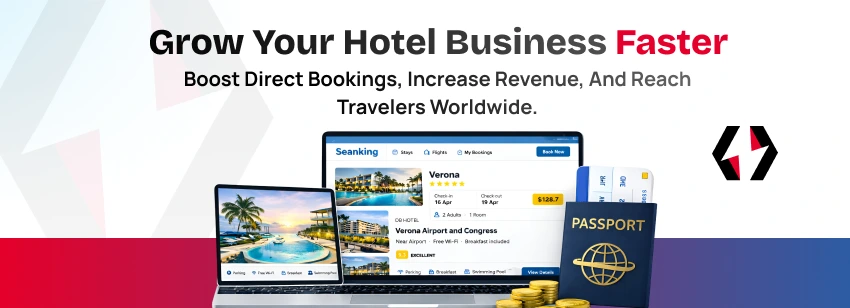
Benefits of developing a hotel booking app like Booking.com
When you conduct hotel booking app development to create aBooking.com clone, it brings a host of benefits into the picture. You begin to get more direct bookings while global reach ensures higher revenues.
Similarly, by creating a high-quality hotel booking app, you’ll be able to promote a state-of-the-art end-user experience, as their bookings will be personalized, instant, and secure. You can encourage repeat bookings by adding features for in-app support, AI recommendations, and loyalty programs. An important advantage that comes into the picture with direct sales is that it creates room for add-in offers, like room upgrades and gym access.
Your app will have features such as detailed analytics for targeted marketing and real-time inventory management. Overall, when you develop a hotel booking app, it brings automation in booking, check-in, and check-out processes. This not only reduces the investment of man-hours needed but also minimizes human errors, such as double bookings.
How you can earn from an app similar to Booking.com
When you develop an app like Booking.com, you’ll monetize it, primarily, by earning a commission on bookings. This will fall somewhere in the line of 10-25%. You might want to charge listing fees from property owners.
Other top monetization schemes that will work for you include:
· Service fees from travelers
· Selling advertising space to airlines and hotels where they’ll display banner ads
· Offering featured listings for a fee
· Merchant model, where visitors pay for the bookings they make on your platform itself
· You could charge a subscription fee from property owners wherein they run unlimited listings and pay a recurring fee.
Cost to build app like Booking.com
Creating an app like Booking.com, when you consider hotel booking app costs, an MVP will cost you around $25,000, but a full-fledged app will be worth $200,000. The top factors that influence this variation in prices are app complexity, tech stack used, features, AI integrations, UI/UX design, the platform used, and 3P integrations.
This investment might be worth it if you have a big idea, keeping in mind that the global market for online travel booking services will be estimated to be worth $1218.9 billion by 2032.
In case you are looking to optimize cost to build an app like Booking.com, you want to start with creating an MVP first wherein the focus solely lies on core features. Do this via cross-platform development and integrate 3P APIs.
You can continue adding advanced features to your app as your business expands, and your app will scale with it. Such an approach will also empower you to provide a matchless travel booking experience for the visitors.
How to choose a software development company to create a hotel booking app like Booking.com
When you choose a development company to create an app like Booking.com, you should lay the priority on a firm that brings alongside proven experience in creating travel apps. Developing travel apps entails many things, including understanding real-time booking engines, GDS integrations, and multi-vendor management. Similarly, it is best if the chosen firm is proficient in cloud computing, cross-platform development, and AI features such as dynamic pricing and recommendation engines.
The firm’s UI/UX capabilities need to be strong, and they should also hold robust experience in payment gateway security, real-time APIs, and AI integrations.
You want to go through their portfolio to find similar projects and consider if they hold expertise in frameworks such as React Native. If you go for a full-cycle development firm, they’ll be able to assist you at every stage, starting from discovery right through to post-launch maintenance.

How to create a hotel booking app like Booking.com
When you create an app like a booking app, you start with a multi-tenant MVP that needs to be robust. One starts with some sound market research and moves on to UI/UX design and development, followed by testing. Let us consider these steps in further detail:
1. Market Research
It is best to bring your focus entirely on a single segment, which could be boutique, luxury, or budget. Another option is to work as a general aggregator.
However, when you study your competitors like Airbnb and Booking.com, you’ll garner a fair idea about user expectations. The next step in line is to identify the core features that the MVP should have, like search filters and secure payments for the customer app and listing creation and inventory management for the hotelier portal.
2. Design and Development
You might want to use a tool such as Figma to create interactive designs. Technology stacks for frontend, backend, and databases are then chosen, and key integrations are then carried out, with Google Maps, payment gateways, and property management systems.
3. Testing and Launch
Carrying out tests for security, usability, and functionality is important, after which the app is launched on the Google Play Store and Apple App Store.
* Key features of online hotel reservation system apps like Booking.com
Among features of a hotel booking app, the most important ones that need to be focused on include
1. A user-friendly interface
2. Inventory synchronization in real-time
3. Secure payment gateways
4. Robust search filters
Similarly, the website needs to be mobile-optimized, as that is where most user interactions will take place. Using the finest photo galleries presents the business in a positive light, while automated confirmation notifications make it reliable. Reviews from verified users make the website trustworthy.
Frontend features
Inventory syncing in real time prevents double bookings. Property listings should be detailed, and while a user should be able to make a booking, he should also be able to cancel bookings. Support for multiple currencies and languages is important when the website goes global.
Administrative and backend features
A robust CMS helps hotels update descriptions and prices. They should be able to send automated notifications and emails to customers. Analytics & Reporting let them garner insights on booking trends, revenue performance, and occupancy rates.
How runtime logics can help you in developing a Booking.com clone
When one goes through Booking.com, one perceives that creating such an app is going to be an expensive affair. But, at Runtime Logics, we make things easier and more affordable for you.
Runtime Logics is your preferred travel app development company, and our knowledge about developing such apps is huge. This works particularly well for entrepreneurs and startups tight on budget.
We recommend that we go ahead with the MVP version first and scale the app based on your business requirements. We bring with us widespread experience in creating secure payments, hotel listings, and flight searches.