
Choosing an eCommerce app development company is not simply about finding a team that can build product pages, shopping carts, and payment screens. A successful eCommerce app needs to connect customer experience with inventory, payments, orders, logistics, analytics, marketing, and business operations.
India has become a major destination for eCommerce technology development, with companies offering everything from custom mobile applications and marketplace platforms to Shopify, Magento, WooCommerce, headless commerce, API integrations, and enterprise solutions. Current 2026 industry directories and search results also show strong demand for companies specializing in eCommerce mobile and software development.
But not every development company is suitable for every type of eCommerce business.
A D2C brand may need a fast, conversion-focused shopping app, while a marketplace may require seller management, commission logic, multiple payment flows, and logistics integrations. An enterprise retailer may instead prioritize ERP integration, scalability, omnichannel commerce, and advanced analytics.
This guide brings together 10 eCommerce app development companies in India for 2026–2027 and compares them based on their relevant development capabilities, eCommerce expertise, technology strengths, portfolio evidence, company information, and suitability for different business requirements.
Introduction: Why Choosing the Right E-Commerce App Development Company Matters
An eCommerce app is much more than a mobile version of an online store.
Behind the customer-facing interface are product catalogs, pricing rules, inventory synchronization, payment gateways, order management, shipping integrations, customer accounts, analytics, notifications, and often multiple third-party APIs.
That is why selecting the right technology partner can have a direct impact on the long-term performance of an eCommerce business.
A good development partner should be able to understand both sides of the project:
- What customers need from the shopping experience
- What the business needs from its technology infrastructure
For example, a fashion retailer may prioritize visual discovery, personalized recommendations, wishlists, and fast checkout. A B2B business may need bulk ordering, custom pricing, approval workflows, and ERP integration. A multi-vendor marketplace needs an entirely different architecture involving sellers, commissions, payouts, inventory, disputes, and logistics.
The companies included in this list represent different strengths across custom eCommerce development, mobile applications, marketplaces, enterprise commerce, Shopify, Magento, API development, cloud, and emerging technologies.
The goal is not simply to identify companies that can build an app. It is to help businesses understand which type of development partner may be the right fit for their specific commerce model.
How We Selected the Top 10 E-Commerce App Development Companies
Rather than copying another “Top 10” list, this ranking uses a practical buyer-focused approach.
Current eCommerce directories use factors such as verified reviews, portfolios, service expertise, pricing, company size, and editorial evaluation.
For this article, the evaluation focuses specifically on factors that matter when hiring an eCommerce app development company.
Evaluation Criteria
1. E-Commerce App Development Expertise – 20%
How strongly the company demonstrates experience with eCommerce applications, mobile commerce, marketplaces, or related digital commerce products.
2. Relevant Portfolio & Project Experience – 15%
Evidence of real eCommerce, retail, marketplace, or commerce-related projects.
3. Technology & Architecture Capability – 15%
Mobile frameworks, backend technologies, APIs, cloud infrastructure, commerce platforms, and ability to support scalable systems.
4. Scalability & Performance – 10%
Ability to build solutions that can handle increasing products, customers, transactions, traffic, and integrations.
5. Integrations & Backend Capability – 10%
Experience with payment gateways, ERP, CRM, inventory, shipping, analytics, and other third-party systems.
6. Reputation & Client Evidence – 10%
Publicly available client reviews, ratings, case studies, and third-party company profiles.
7. Industry & Business-Model Experience – 10%
Experience across B2C, B2B, D2C, retail, marketplaces, grocery, enterprise, and other commerce models.
8. Post-Launch Support – 5%
Maintenance, optimization, updates, and ongoing technical support.
9. Commercial Flexibility – 5%
Suitability for startups, SMEs, growing businesses, and enterprise organizations.
The rankings should be viewed as a research-based editorial shortlist, not a guarantee that one company will be the best choice for every project. Businesses should independently verify current pricing, team size, portfolio information, availability, and technical capabilities before signing a contract.
Quick Comparison: Top 10 E-Commerce App Development Companies in India
| Rank | Company | Founded | Key Strength | Best For |
| 1 | Runtime Logics | 2017 | Custom mobile & eCommerce applications | Startups, SMEs, custom commerce |
| 2 | Webatlas Tech | 2017 | Custom software, mobile apps & eCommerce platforms | Growing businesses & custom products |
| 3 | MOBIKASA | 2011 | Digital commerce, Shopify, Magento & mobile | D2C, retail & enterprise brands |
| 4 | EbizON Digital | 2007 | eCommerce, mobile commerce & digital activation | Growing brands & retailers |
| 5 | Digital Aptech | 2013 | Custom eCommerce & mobile applications | SMBs, enterprises & custom platforms |
| 6 | Brainium Information Technologies | 2013 | eCommerce, mobile apps & AI-first development | SMEs & mid-market businesses |
| 7 | Smarther Technologies | 2011 | Mobile commerce & ready-to-launch solutions | Startups, SMEs & retail businesses |
| 8 | Konstant Infosolutions | 2003 | Mobile app & eCommerce development | Businesses needing long-term app expertise |
| 9 | ControlF5 | 2012 | Shopify, eCommerce & mobile solutions | D2C, B2C & Shopify businesses |
| 10 | Tridhya Tech | 2018 | Enterprise eCommerce, Magento & mobile | Enterprise & B2B/B2C businesses |
Company information and service capabilities can change, so readers should verify current details directly with each provider. For example, current public profiles identify Runtime Logics as founded in 2017, EbizON as founded in 2007, Digital Aptech as founded in 2013, Brainium as founded in 2013, and Konstant Infosolutions as founded in 2003.
Top 10 E-Commerce App Development Companies in India 2026–2027
1. Runtime Logics
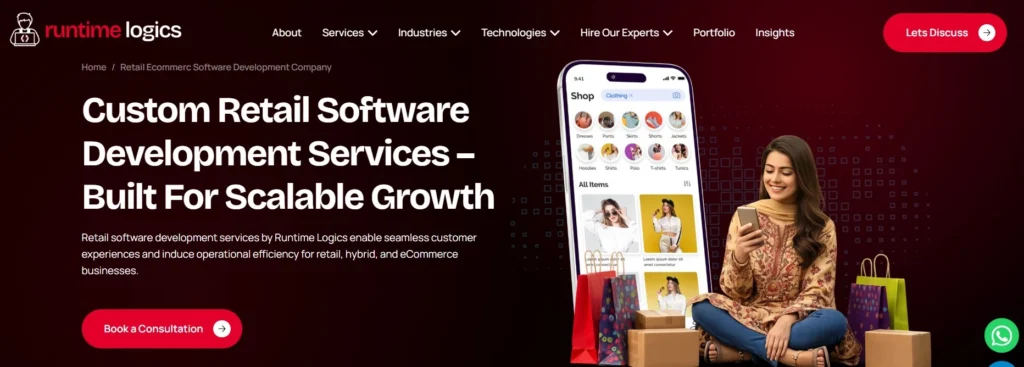
Runtime Logics is a custom software and mobile app development company helping businesses build scalable eCommerce experiences with modern technologies and business-focused functionality.
Company Overview
Runtime Logics ranks first for its combination of custom eCommerce, mobile app, and full-stack development capabilities. The company builds iOS, Android, and cross-platform applications for businesses looking to create customized shopping experiences rather than relying entirely on pre-built solutions.
Its eCommerce development capabilities can support shopping apps, D2C platforms, retail solutions, and marketplace-oriented applications with features such as product catalogs, customer accounts, payments, order management, notifications, and third-party integrations.
The company works with technologies including Flutter, React Native, Swift, Kotlin, Node.js, Firebase, PostgreSQL, and MongoDB. Its broader services also include API development, UI/UX, web applications, cloud, and ongoing maintenance, allowing businesses to connect their mobile commerce experience with backend systems.
Runtime Logics is particularly suitable for startups, SMEs, and growing businesses looking for a flexible development partner capable of building and scaling custom digital commerce products.
Additional Details
- Company Name – Runtime Logics
- Website: www.runtimelogics.com
- Company Size: 10–50 Employees
- Email: info@runtimelogics.com
- Phone: +91 62 62 62 9320
2. Webatlas Tech
Webatlas Tech is a digital product engineering company providing custom software, mobile applications, eCommerce solutions, and scalable technology platforms.
Company Overview
Webatlas Tech ranks second because of its combination of custom software engineering, mobile development, and eCommerce product experience. The company works on digital products where businesses require functionality beyond a standard online store.
Its portfolio includes Raprod, a bidding-based eCommerce platform connecting businesses with verified manufacturers, demonstrating experience with commerce workflows and business-oriented digital platforms.
Webatlas Tech provides web and mobile development using technologies such as React, Node.js, .NET, Flutter, React Native, and cloud platforms including AWS, Azure, and Google Cloud. This technology flexibility can be useful for businesses requiring customized frontend experiences, backend systems, APIs, and integrations.
For eCommerce businesses, its capabilities can support custom shopping platforms, B2B commerce, marketplace-style products, and other digital commerce applications. The company can be a suitable option for businesses that prioritize customized workflows, scalable architecture, and broader software development expertise.
Additional Details
- Company Name – Webatlas Tech
- Website: www.webatlastech.com
- Company Size: 50–100 Employees
- Email: info@webatlas.tech
- Phone: +91 82880 72228
3. Techno Tech
Technotech India is a Surat-based technology company offering website development, mobile applications, and digital marketing services for businesses.
Company Overview
Technotech India is included in this list for its experience across website development, mobile application development, and digital services. The company states that it has more than eight years of experience and has delivered more than 150 projects across different business requirements.
Its development services include website design and development as well as Android and iOS application development. For eCommerce businesses, this combination can help support a connected web and mobile presence, particularly for businesses that are expanding their digital sales channels.
Technotech India also provides SEO and digital marketing services, allowing businesses to combine application development with online visibility and customer acquisition activities.
Its positioning is more suitable for businesses looking for a combination of web, mobile, and digital services rather than highly specialized enterprise commerce architecture. Companies with complex marketplace, ERP, or large-scale commerce requirements should evaluate its specific technical portfolio and project experience before selecting the company.
Additional Details
- Company Name: Technotech India
- Website: www.technotechindia.com
- Company Size: 50–100 Employees
4. Appinventiv
Appinventiv is a digital product engineering company developing mobile commerce applications, eCommerce platforms, marketplaces, and enterprise digital solutions.
Company Overview
Appinventiv is positioned strongly for businesses with complex eCommerce and digital transformation requirements. Founded in 2015, the company has grown into a large technology organization with a team of 1,700+ technology professionals.
Its eCommerce capabilities cover multiple business models, including B2B, B2C, multi-vendor marketplaces, subscription commerce, quick commerce, omnichannel commerce, and headless commerce. This makes its services relevant for businesses that need more than a basic shopping application.
Appinventiv works with platforms and technologies such as Shopify Plus, Adobe Commerce, BigCommerce, Salesforce Commerce Cloud, React, Next.js, Node.js, and mobile development technologies. It also supports integrations involving ERP, CRM, payment systems, logistics, analytics, and other business platforms.
The company is particularly suitable for established businesses and enterprises looking for a larger engineering partner to develop, integrate, and scale complex commerce ecosystems.
Additional Details
- Company Name: Appinventiv Technologies Pvt. Ltd.
- Website: www.appinventiv.com
- Company Size: 1,700+ Technology Experts
5. ScienceSoft
ScienceSoft is an established software engineering and IT consulting company with extensive experience in eCommerce, mobile commerce, enterprise applications, and digital transformation.
Company Overview
ScienceSoft brings decades of software engineering experience and more than two decades of dedicated eCommerce expertise. Founded in 1989, the company reports more than 750 IT professionals and thousands of completed projects across multiple industries and countries.
Its eCommerce services cover consulting, custom development, mobile commerce, UX/UI, integrations, optimization, maintenance, and support. The company works with businesses that require structured and scalable commerce solutions rather than simple storefront development.
For mobile commerce, ScienceSoft supports business analysis, UX/UI design, native and cross-platform application development, integration, testing, and ongoing maintenance. Its broader expertise in cloud, cybersecurity, data analytics, AI, and enterprise software can also support larger commerce ecosystems.
ScienceSoft is particularly relevant for established organizations that need enterprise-grade engineering capabilities, integration expertise, security considerations, and long-term technology support for their eCommerce initiatives.
Additional Details
- Company Name: ScienceSoft USA Corporation
- Website: www.scnsoft.com
- Company Size: 750+ IT Professionals
6. SoftTeco
SoftTeco is an international software development company delivering custom eCommerce applications, mobile commerce solutions, platform migration, and technology services.
Company Overview
SoftTeco has been providing software development services since 2008 and currently reports more than 500 employees and 650 delivered projects. The company also highlights ISO 9001 and ISO 27001 certifications, which can be relevant for businesses handling customer and transaction data.
Its eCommerce services cover B2B, B2C, C2C, and C2B applications, along with custom development, mobile commerce migration, UX/UI, integrations, and post-launch maintenance. The company supports both native and cross-platform mobile development and works with platforms such as Shopify and Magento.
SoftTeco’s wider technical capabilities include backend and frontend development, mobile applications, cloud, DevOps, machine learning, databases, and QA automation.
This combination makes the company a potential fit for businesses that want to move from traditional web commerce toward mobile commerce or require an eCommerce application connected to a broader technology ecosystem.
Additional Details
- Company Name: SoftTeco
- Website: www.softteco.com
- Company Size: 500+ Employees
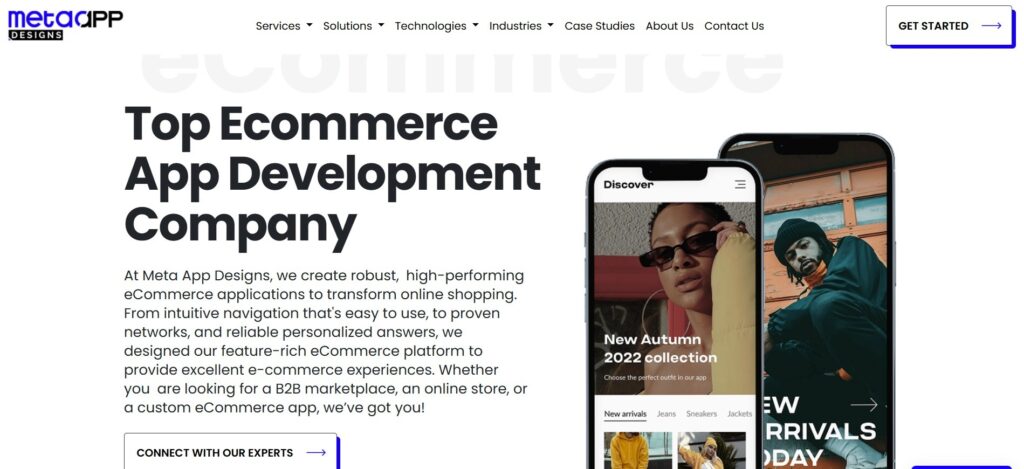
7. Meta App Designs
Meta App Designs is a mobile app development company specializing in eCommerce, retail, grocery, and AI-powered shopping applications.
Company Overview
Meta App Designs focuses heavily on mobile product development, making it relevant for businesses looking to create mobile-first commerce experiences. The company states that its team has more than 10 years of experience and has developed more than 80 applications.
Its eCommerce capabilities cover shopping applications, retail platforms, grocery apps, subscription commerce, social commerce, and live-shopping experiences. The company emphasizes features such as personalized shopping, product discovery, and customer engagement.
Its technology stack includes Flutter, React Native, Android, iOS, React, Angular, Vue.js, Next.js, Laravel, Node.js, PHP, MySQL, MongoDB, and PostgreSQL.
Meta App Designs also highlights AI-powered retail capabilities, including AI chatbots, virtual try-on experiences, image recognition, and personalized shopping features. This makes it particularly interesting for brands exploring interactive and AI-assisted commerce experiences rather than a conventional shopping application.
Additional Details
- Company Name: Meta App Designs
- Website: www.metaappdesigns.com
- Company Size: 500+ Employees
8. Esferasoft Solutions
Esferasoft Solutions is a software development and digital transformation company offering eCommerce applications, marketplaces, mobile apps, AI solutions, and enterprise technology services.
Company Overview
Esferasoft Solutions has extensive experience across software development and digital transformation. The company reports more than 19 years of experience, 2,500+ clients, operations across 50+ countries, and more than 2,000 digital solutions launched.
Its eCommerce services include custom shopping applications, eCommerce websites, marketplace platforms, and multi-sided ecosystems involving customers, vendors, administrators, and delivery partners. The company also highlights features such as personalized recommendations, smart search, order tracking, secure checkout, and push notifications.
Esferasoft works with platforms and technologies including Shopify, WooCommerce, Magento, React Native, Laravel, Node.js, Next.js, Flutter, Java, Kotlin, Swift, and cloud platforms.
Its broader capabilities in AI, analytics, APIs, cloud, and enterprise development allow it to support businesses looking for a complete digital commerce ecosystem rather than only a customer-facing mobile application.
Additional Details
- Company Name: Esferasoft Solutions
- Website: www.esferasoft.com
- Company Size: 500+ Employees
9. SparxIT
SparxIT is a digital transformation company offering eCommerce applications, mobile commerce solutions, marketplace development, and custom software services.
Company Overview
SparxIT has been operating since 2007 and provides services across mobile applications, web development, eCommerce, cloud, and digital transformation. The company supports multiple commerce models, including B2B, B2C, C2C, multi-vendor, mobile commerce, PWA, and omnichannel solutions.
Its eCommerce development services include custom application development, payment integration, CRM integration, UI/UX, migration, modernization, and post-launch support. The company also works with technologies such as Flutter, React Native, Swift, Kotlin, Node.js, React, Angular, Vue.js, AWS, Azure, and Google Cloud.
SparxIT’s current public portfolio and third-party reviews provide evidence of cross-platform eCommerce application development, including Flutter-based projects.
The company can be considered by businesses looking for a development partner capable of handling both customer-facing applications and supporting digital infrastructure, particularly when the project involves multiple commerce channels or modernization of an existing platform.
Additional Details
- Company Name: SparxIT
- Website: www.sparxitsolutions.com
- Company Size: 250+ IT Professionals
10. Excellent WebWorld
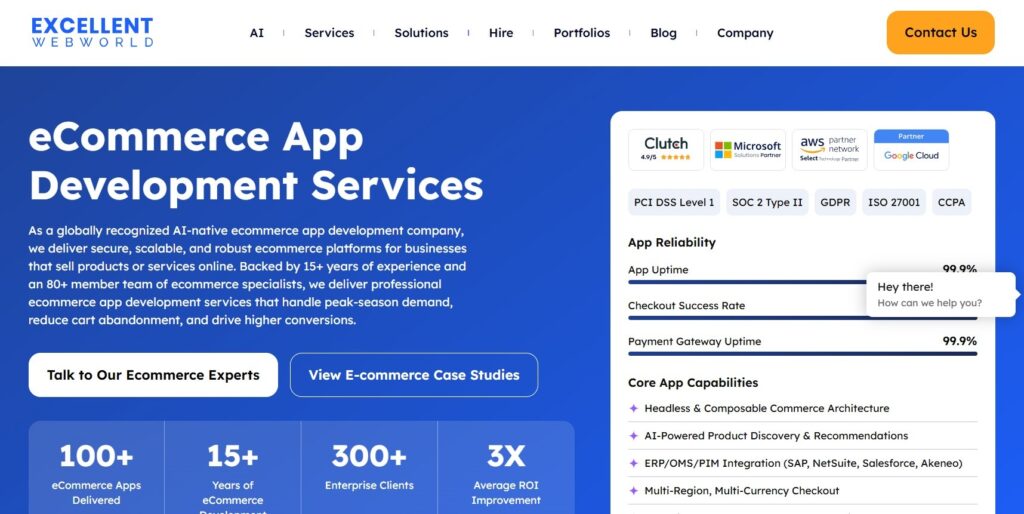
Excellent WebWorld is a software and mobile app development company building eCommerce applications, marketplaces, retail platforms, and AI-powered commerce solutions.
Company Overview
Excellent WebWorld has more than 15 years of experience in software and mobile application development and reports 600+ global clients, 900+ projects, and a technology team of more than 300 professionals. The company serves multiple industries, including eCommerce and retail.
Its eCommerce services focus on mobile-first shopping experiences, personalized product discovery, conversion-focused interfaces, order management, and scalable commerce platforms. The company works with platforms such as Shopify, WooCommerce, Adobe Commerce, Salesforce Commerce Cloud, PrestaShop, Wix, and OpenCart.
Its mobile technology capabilities include Flutter, React Native, Swift, and Kotlin, while backend development covers Node.js, Python, Java, .NET, and PHP.
Excellent WebWorld also highlights AI-powered commerce capabilities such as visual search, personalized recommendations, and AI-enabled marketplace experiences. This positions the company well for businesses looking to combine traditional eCommerce functionality with newer AI-driven shopping experiences.
Additional Details
- Company Name: Excellent WebWorld
- Website: www.excellentwebworld.com
- Company Size: 500+ Employees
What Kind of E-Commerce App Can You Build?
Not every eCommerce application needs the same architecture or feature set. Before approaching a development company, businesses should define the commerce model they are trying to support.
B2C E-Commerce Apps
A B2C app connects a business directly with consumers.
Typical requirements include:
- Product catalog
- Search and filters
- Product details
- Shopping cart
- Checkout
- Payment gateway
- Order tracking
- Reviews and ratings
- Push notifications
- Customer support
This model is suitable for fashion, electronics, beauty, lifestyle, home products, and many other retail categories.
D2C E-Commerce Apps
D2C applications allow brands to sell directly to their customers without relying entirely on third-party marketplaces.
The focus is often on:
- Brand experience
- Customer data
- Personalization
- Loyalty
- Subscriptions
- Repeat purchases
- First-party customer relationships
Multi-Vendor Marketplace Apps
Marketplace apps connect multiple sellers with customers.
They usually require:
- Seller registration
- Seller dashboard
- Product management
- Commission management
- Seller payouts
- Customer reviews
- Order management
- Dispute handling
- Inventory synchronization
The additional user roles and workflows make marketplace development substantially more complex than a single-brand shopping app.
Grocery & Quick-Commerce Apps
These applications need additional operational capabilities such as:
- Location services
- Store selection
- Delivery slots
- Real-time inventory
- Delivery partner management
- Live order tracking
- Substitution management
B2B E-Commerce Apps
B2B commerce often requires features that are not necessary in consumer shopping apps:
- Bulk ordering
- Custom pricing
- Quote requests
- Purchase approvals
- Credit limits
- Account-based catalogs
- Repeat orders
- ERP integration
The key takeaway is simple: define the commerce model before defining the technology.
What Should a Modern E-Commerce App Include in 2026–27?
A modern eCommerce app should not be judged by how many features it has. The better question is whether its features make shopping easier and business operations more efficient.
Customer Experience Features
- Simple registration and login
- Smart product search
- Advanced filters
- Personalized recommendations
- Wishlist
- Product comparison
- Product reviews
- Multiple payment options
- Fast checkout
- Order tracking
- Push notifications
- Customer support
Commerce Features
- Product catalog management
- Multiple product variants
- Inventory management
- Coupon and discount management
- Tax management
- Order management
- Returns and refunds
- Multiple currencies
- Multiple languages
Growth Features
- Loyalty programs
- Referral systems
- Personalized offers
- Abandoned-cart notifications
- Customer segmentation
- Analytics dashboards
- Campaign management
AI-Powered Features
AI can be useful when it solves a real commerce problem.
Examples include:
- Personalized product recommendations
- AI shopping assistants
- Natural-language product search
- Automated customer support
- Product categorization
- Customer behavior analysis
- Dynamic merchandising
- Recommendation-based upselling
AI should not simply be added because it is trending. The business case should come first.
Integration Features
A scalable eCommerce app may need to connect with:
- ERP
- CRM
- PIM
- Payment gateways
- Shipping providers
- Warehouse management
- Marketing automation
- Analytics platforms
- Customer support tools
The more integrated the business becomes, the more important backend architecture and API design become.
Technology Stack for E-Commerce Apps: What Should You Choose?
The technology stack should be selected according to the business requirements rather than following a trend.
Mobile Development
Flutter
Useful when a business wants Android and iOS applications from a shared codebase and needs consistent UI development.
React Native
A strong option for cross-platform applications where businesses want JavaScript/TypeScript-based development and reusable components.
Native iOS and Android
Swift and Kotlin are suitable when the project requires platform-specific capabilities, deep device integration, or highly specialized performance requirements.
Backend Development
Common choices include:
- Node.js
- Laravel/PHP
- Java
- .NET
- Python
The correct backend depends on the application’s complexity, integrations, developer availability, scalability requirements, and existing business systems.
E-Commerce Platforms
Businesses may choose:
- Shopify
- Shopify Plus
- WooCommerce
- Magento / Adobe Commerce
- BigCommerce
- Custom commerce backend
- Headless commerce
Custom vs Platform-Based Development
A Shopify or WooCommerce-based approach can be suitable when the business wants to launch quickly and its requirements fit the platform.
Custom development becomes more attractive when the business needs:
- Unique workflows
- Complex marketplace logic
- Custom pricing
- Advanced integrations
- Specialized customer journeys
- Proprietary business processes
- Greater control over architecture
When Should You Consider Headless Commerce?
Headless commerce separates the customer-facing experience from the commerce backend.
It can make sense when a business needs the same commerce infrastructure to support:
- Mobile apps
- Websites
- Progressive web apps
- In-store experiences
- Marketplaces
- Other digital channels
The key is to avoid choosing headless architecture simply because it sounds more advanced. Architecture should solve a business requirement.
How Much Does E-Commerce App Development Cost in India in 2026–27?
There is no universal price for an eCommerce app because two applications can have completely different levels of complexity.
Recent 2026 estimates published by Indian development companies commonly place basic or standard eCommerce apps in the single-digit to mid-teens lakh range, while marketplaces and enterprise applications can move considerably higher.
For planning purposes, businesses can consider the following broad ranges:
| E-Commerce App Type | Approx. Development Budget |
| Basic / MVP App | ₹4–8 lakh |
| Standard Custom E-Commerce App | ₹8–15 lakh |
| Advanced E-Commerce App | ₹15–30 lakh |
| Multi-Vendor Marketplace | ₹15–35+ lakh |
| Enterprise / Advanced Commerce Platform | ₹30–70+ lakh |
These are planning ranges, not fixed quotations.
What Increases the Cost?
1. Number of Platforms
Building Android only is different from building Android + iOS + web.
2. UI/UX Complexity
Custom animations, personalization, advanced product discovery, and complex checkout flows require additional design and development work.
3. Backend Architecture
A basic store has a relatively simple backend. A marketplace or enterprise platform may need complex services and multiple APIs.
4. Third-Party Integrations
Examples include:
- Razorpay
- Stripe
- PayPal
- Shipping APIs
- ERP
- CRM
- PIM
- Analytics
- Marketing automation
5. Marketplace Functionality
Seller onboarding, commission management, payouts, vendor dashboards, disputes, and multiple inventories increase development effort.
6. AI Features
AI recommendations, conversational shopping, personalization, and predictive analytics can add development and infrastructure costs.
7. Security & Compliance
Payment security, data protection, authentication, access controls, and security testing should be included in the project plan.
Don’t Forget the Ongoing Costs
Your development budget should also account for:
- Cloud hosting
- Payment gateway fees
- SMS/OTP
- Third-party API charges
- App store accounts
- Maintenance
- Security updates
- Analytics
- Customer support
- Marketing and app acquisition
The cheapest development quote is not necessarily the lowest total cost of ownership.
How Long Does It Take to Build an E-Commerce App?
The timeline depends heavily on the business model and feature scope.
A rough planning framework is:
| Project Type | Approx. Timeline |
| Basic E-Commerce MVP | 8–12 weeks |
| Standard Custom App | 3–5 months |
| Advanced E-Commerce App | 4–6 months |
| Multi-Vendor Marketplace | 5–9 months |
| Enterprise Commerce Platform | 6–12+ months |
Recent 2026 industry estimates also place single-vendor applications around 8–12 weeks and more complex marketplaces around several months.
Typical Development Process
1. Discovery & Requirements
Define the business model, users, workflows, integrations, and goals.
2. Product Strategy
Prioritize MVP features and define the technology architecture.
3. UI/UX Design
Create wireframes, user flows, prototypes, and visual designs.
4. Development
Build the mobile application, backend, APIs, admin panel, and integrations.
5. QA & Testing
Test functionality, performance, security, usability, payments, and different devices.
6. Launch
Prepare the application for App Store and Google Play submission.
7. Post-Launch Optimization
Monitor analytics, fix issues, improve conversion, and introduce new features.
A smaller MVP can therefore launch much sooner than a full Amazon-style marketplace.
How to Choose the Right E-Commerce App Development Company
The right company should be selected based on fit, not just ranking.
Before signing an agreement, ask these questions:
1. Have you built an eCommerce app similar to mine?
A company that has built a grocery marketplace may not automatically be the best fit for a complex B2B commerce platform.
2. Can you show relevant case studies?
Ask for projects with similar:
- Business model
- Customer type
- Product catalog
- Integrations
- Scale
3. Who will own the source code?
Clarify intellectual property ownership before development begins.
4. How will the application scale?
Ask how the architecture will handle:
- More users
- More products
- Higher order volume
- Traffic spikes
- Additional integrations
5. How will inventory synchronization work?
Inventory problems can create overselling, cancellations, and poor customer experiences.
6. What payment integrations can you support?
Ask about local and international payment requirements.
7. What is included after launch?
Clarify:
- Bug fixing
- Security updates
- OS compatibility
- App updates
- Performance monitoring
- Feature enhancements
8. What is the development methodology?
Understand how the company handles:
- Milestones
- Testing
- Communication
- Change requests
- Project management
9. Can you help with architecture decisions?
A strong partner should be able to explain why a particular architecture is appropriate—not simply recommend the technology they already use.
10. Can you build the backend as well as the mobile application?
For serious eCommerce projects, mobile development and backend engineering need to work together.
One Question Many Buyers Forget
“Can you show me the architecture?”
A beautiful application demo does not tell you whether the backend can handle thousands of concurrent users, inventory synchronization, payment failures, API downtime, or future integrations.
Red Flags to Watch for Before Hiring an E-Commerce App Development Company
Before choosing a development partner, look for warning signs that could create problems later.
Red Flag #1: Unrealistically Low Quotes
A very low price may mean critical components such as QA, security, backend development, or post-launch support have not been included.
Red Flag #2: No Relevant Portfolio
A company may have dozens of mobile apps but no meaningful eCommerce experience.
Red Flag #3: Generic Technical Answers
If the development team cannot explain its approach to APIs, databases, inventory, payments, security, or scalability, investigate further.
Red Flag #4: No Clear Source-Code Ownership
The contract should clearly state who owns the code and intellectual property after payment.
Red Flag #5: Everything Is “Custom”
Custom development is valuable, but rebuilding functionality already solved reliably by established platforms or APIs can increase cost without adding business value.
Red Flag #6: Unrealistic Timelines
A full marketplace with customer, vendor, delivery, admin, payment, and inventory systems cannot realistically be treated like a small five-screen application.
Red Flag #7: No Post-Launch Plan
An eCommerce application needs updates, monitoring, bug fixes, OS compatibility, security improvements, and ongoing optimization.
Red Flag #8: No Testing Strategy
Ask whether the team tests:
- Payments
- Checkout
- APIs
- Devices
- Performance
- Security
- Notifications
- Order workflows
A successful launch is only the beginning of an eCommerce product’s lifecycle.
E-Commerce App Development Trends to Watch in India: 2026–27
The next phase of eCommerce app development is less about adding more screens and more about making commerce experiences intelligent, connected, and frictionless.
AI-Powered Personalization
AI can analyze customer behavior and product interactions to support recommendations, personalized offers, and better product discovery.
Conversational Shopping
AI assistants can help users search for products, compare options, answer questions, and guide them toward purchases.
Smarter Product Search
Traditional keyword search is increasingly being supplemented by:
- Natural-language search
- Voice search
- Visual search
- AI-assisted recommendations
Headless & Composable Commerce
Businesses with complex digital ecosystems may increasingly separate their commerce backend from their customer-facing interfaces.
This can allow one commerce engine to support mobile apps, websites, kiosks, and other channels.
Omnichannel Commerce
Customers may discover a product on one channel, purchase on another, and collect or return it through another.
Apps therefore need to connect with:
- Websites
- Physical stores
- Marketplaces
- Inventory systems
- Customer support
- Logistics
Faster Checkout
Reducing checkout friction remains one of the most practical areas for optimization.
Businesses should focus on:
- Fewer steps
- Saved addresses
- Multiple payment options
- Wallets
- UPI
- Reliable payment recovery
- Clear delivery information
First-Party Customer Data
As businesses focus more on direct customer relationships, eCommerce apps can become an important source of first-party behavioral and purchase data.
The technology strategy should therefore consider not only the customer interface but also how customer information is collected, secured, analyzed, and used responsibly.
Final Takeaway
Choosing an eCommerce app development company should not come down to finding the company with the longest service list or the lowest quotation.
The better approach is to start with your business model.
Are you building a D2C shopping app? A B2B commerce platform? A multi-vendor marketplace? A grocery application? Or an enterprise omnichannel ecosystem?
Once the business model is clear, evaluate development companies based on their relevant experience, technical capabilities, architecture approach, portfolio, integration expertise, scalability, support model, and ability to understand your customers.
The companies in this list provide different strengths across mobile app development, custom software, eCommerce platforms, marketplaces, enterprise commerce, AI, and digital transformation.
For businesses considering a custom eCommerce application, the most important decision is not simply “Who can build my app?”
It is:
“Who can build the right commerce technology for where my business is today—and where I want it to go next?”