
The fitness industry is moving beyond basic workout logs and step counters. Modern fitness applications combine personalized workouts, nutrition tracking, wearable synchronization, AI-powered coaching, real-time analytics, subscriptions, social engagement, and connected health experiences.
For businesses planning to launch a fitness product in 2026–27, choosing the right development partner is therefore about more than finding a company that can build an iOS or Android application. You need a team that understands product strategy, user engagement, wearable integrations, scalable backend architecture, AI, data security, and long-term product growth.
To help businesses make a more informed decision, we researched current 2026 fitness app development rankings, company capabilities, published service information, and fitness-specific technology expertise.
This guide lists the Top 10 Fitness App Development Companies in USA for 2026–27, with Runtime Logics and Webatlas Tech leading the list, followed by other companies with relevant mobile, fitness, wellness, digital health, AI, wearable, and enterprise product capabilities.
Quick Comparison: Top 10 Fitness App Development Companies in USA
| Rank | Company | Best For | Key Strength |
| 1 | Runtime Logics | Custom fitness apps | Mobile, AI, wearables & API integration |
| 2 | Webatlas Tech | Custom and scalable fitness products | Mobile, AI, cloud & real-time development |
| 3 | Wildnet Edge | AI-driven fitness ecosystems | AI, computer vision & wearable integration |
| 4 | MindSea | Digital health & fitness products | UX, health apps & wearable-connected solutions |
| 5 | Dogtown Media | Health, fitness & IoT applications | Mobile, IoT & connected devices |
| 6 | Zco Corporation | Enterprise fitness solutions | Mobile, custom software & connected products |
| 7 | TechAhead | AI-powered fitness applications | AI, cloud, mobile & scalable architecture |
| 8 | Apptunix | Feature-rich fitness platforms | AI, IoT, marketplaces & mobile |
| 9 | BlueLabel | Consumer fitness & health products | Product strategy, UX & engineering |
| 10 | WillowTree | Enterprise-scale digital experiences | Product design, mobile & enterprise engineering |
How We Selected These Fitness App Development Companies
Many existing “Top 10 Fitness App Development Companies” articles rely mainly on company size, ratings, years of experience, or general mobile development capabilities.
For this guide, we used a more fitness-specific evaluation approach.
Our Ranking Criteria
| Evaluation Factor | Weight |
| Fitness & wellness product capabilities | 20% |
| AI & personalization | 15% |
| Wearable & health-data integration | 15% |
| Mobile UI/UX | 10% |
| Backend & scalability | 10% |
| Real-time data capabilities | 10% |
| Security & sensitive-data handling | 10% |
| Cross-platform development | 5% |
| Post-launch support | 5% |
| Total | 100% |
This approach is designed to answer a practical question:
Which development company could be a suitable technology partner for the type of fitness product you want to build?
1. Runtime Logics
Runtime Logics is a trusted Fitness App Development Company creating scalable fitness apps with smart features, seamless UX, and reliable performance. Today.
Company Overview
Runtime Logics ranks first in this list because its mobile development capabilities align closely with the technology requirements of modern fitness products. The company provides custom mobile app development for Android and iOS and supports cross-platform frameworks including Flutter and React Native. Its published capabilities also cover AI, IoT, ML, wearable application development, real-time analytics, and integrations with third-party systems and smart devices.
For a fitness business, this combination can support different types of products, including workout applications, fitness tracking platforms, personal trainer apps, nutrition applications, wellness platforms, gym applications, and wearable-connected fitness solutions.
Runtime Logics follows a full-cycle development approach that starts with discovery and validation, moves through product strategy and UI/UX, and continues into development, testing, deployment, and post-launch support. Its published mobile technology stack includes Flutter, React Native, Swift, Kotlin, Node.js, Firebase, PostgreSQL, and MongoDB.
The company also highlights AI-powered personalization, which can be particularly relevant to fitness applications where recommendations can be adapted around user behavior, preferences, activity, and goals.
Additional Details
- Company Name – Runtime Logics
- Website: www.runtimelogics.com
- Company Size: 10–50 Employees
- Email: info@runtimelogics.com
- Phone: +91 62 62 62 9320
2. Webatlas Tech
Webatlas Tech is a leading Fitness App Development Company creating engaging, scalable fitness apps with modern technology, intuitive UX, and powerful features.
Company Overview
Webatlas Tech ranks second for its broad custom development capabilities and technology coverage. The company provides mobile application development for businesses and supports native as well as cross-platform development using technologies such as Swift, Kotlin, Flutter, and React Native. Its published technical capabilities also include Node.js, Python, AI/ML, cloud platforms, databases, real-time communication, APIs, and DevOps.
These capabilities can translate well into fitness applications that require more than a basic mobile interface. A modern fitness product may need a customer application, trainer dashboard, admin panel, payment system, analytics layer, real-time communication, cloud infrastructure, and integrations with external services.
Webatlas Tech also promotes AI and machine learning development, cloud technologies, full-stack engineering, and scalable digital products.
For fitness businesses, its technology stack can support workout platforms, personal trainer applications, fitness marketplaces, subscription-based applications, activity tracking products, and wellness platforms.
The company’s development approach emphasizes custom solutions rather than forcing every business into the same application structure.
Additional Details
- Company Name – Webatlas Tech
- Website: www.webatlastech.com
- Company Size: 50–100 Employees
- Email: info@webatlas.tech
- Phone: +91 82880 72228
3. Wildnet Edge
Wildnet Edge is a Fitness App Development Company delivering custom fitness apps with intuitive designs, robust technology, and smart features. For all brands.

Company Overview
Wildnet Edge appears repeatedly in current 2026 fitness app development rankings, particularly for AI-powered fitness products, wearable ecosystems, and enterprise-level wellness platforms. Its published fitness capabilities include AI-powered fitness tracking, personalized experiences, wearable integration, computer vision, and scalable digital fitness platforms.
The company’s fitness offering goes beyond simple workout logging. Its published examples include AI-based movement analysis, yoga pose correction, corporate wellness systems, smart gym solutions, and wearable-connected applications.
This makes the company particularly relevant for businesses planning technically complex fitness ecosystems where AI, connected devices, personalization, analytics, and enterprise infrastructure are important.
Its current fitness development positioning highlights more than 19 years of product engineering experience, a team of 350+ engineers, and an enterprise-oriented development approach.
Additional Details
- Company Name: Wildnet Edge
- Website: www.wildnetedge.com
- Company Size: 350+ Employees
4. MindSea
MindSea builds innovative fitness apps with thoughtful UX, modern technology, and scalable solutions, making us a reliable Fitness App Development Company.
Company Overview
MindSea brings a strong digital health perspective to fitness application development. The company has worked on mobile and web applications since 2007 and identifies fitness and wellness companies among the organizations it serves. It also offers wearable and sensor-connected application development, which can be highly relevant to fitness products.
Its current digital health services include mobile apps, wearable and sensor-connected applications, healthcare AI, EHR/EMR integrations, and secure health-focused software.
For fitness businesses, this is particularly useful when the product involves health-related data, wearable synchronization, monitoring, personalization, or integration with broader health ecosystems.
MindSea also follows a blueprint-led approach that focuses on product planning, UX, technical architecture, priorities, timelines, and risk reduction before development begins.
Although headquartered in Halifax, Canada, MindSea maintains a Boston presence and serves clients across the United States and Canada.
Additional Details
- Company Name: MindSea
- Website: www.mindsea.com
- Company Size: 50+ Employees
5. Trembit
Dogtown Media creates custom fitness apps with engaging experiences, connected features, and scalable technology for businesses seeking expert app development.
Company Overview
Trembit stands out for its specialized focus on technically complex fitness platforms rather than treating fitness as just another mobile app category. Its dedicated fitness development offering highlights 50+ health and fitness projects and more than 10 million end users on platforms it has built. The company focuses on solving common technical challenges in fitness applications, including live workout streaming, wearable synchronization, real-time sensor data, personalized workout logic, and scalable infrastructure.
Its fitness development capabilities cover both new product development and existing application modernization. Trembit states that it can build custom fitness platforms with live and on-demand workout streaming, adaptive workout engines, progression systems, wearable integrations, and subscription functionality.
The company also has a strong connected-fitness technology stack. Its published technologies include Apple HealthKit, Google Fit, Fitbit SDK, Garmin Connect IQ, Bluetooth LE, ANT+, React Native, Flutter, Swift, Kotlin, Node.js, Python, Go, PostgreSQL, Redis, and Kafka. Its AI capabilities include workout recommendations, computer-vision-based rep counting, progression algorithms, nutrition planning, and injury-risk prediction.
Additional Details
6. Zco Corporation
TechAhead is a trusted Fitness App Development Company delivering custom, scalable apps with intuitive UX, smart features, and seamless digital experiences.
Company Overview
Zco Corporation has been operating since 1989 and is headquartered in Nashua, New Hampshire. The company states that its team includes more than 250 programmers, artists, and project managers and that it has delivered software for startups as well as Fortune 500 organizations.
Zco also has a dedicated fitness app development offering covering areas such as fitness tracking, wearables, diet and nutrition, personal training, gym applications, meditation, and gamification.
For businesses planning a fitness application that needs long-term technical support, enterprise integration, or connected-device functionality, Zco’s long operating history can be an important consideration.
Its fitness development capabilities include wearable integrations, Apple Watch, Fitbit, Pixel Watch, HealthKit, Flutter, and React Native.
The company also publishes fitness app cost guidance, estimating that basic apps can start around $40,000, medium-complexity products around $100,000, and complex applications around $200,000 or more. These should be treated as planning figures rather than fixed quotes.
Additional Details
- Company Name: Zco Corporation
- Website: www.zco.com
- Company Size: 250+ Employees
7. TechAhead
Apptunix builds custom fitness apps with smart features, engaging UX, and scalable technology, helping fitness businesses deliver better digital experiences.
Company Overview
TechAhead has been operating since 2009 and is headquartered in Agoura Hills, California. The company reports a team of roughly 250–300 professionals and more than 2,500 platforms, products, and enterprise systems delivered.
Its capabilities cover mobile application development, AI/ML, cloud engineering, IoT, UX/UI, and enterprise software. These technologies can support modern fitness applications that require AI-based personalization, real-time analytics, wearable connectivity, and scalable backend architecture.
TechAhead also publishes dedicated fitness app development services covering custom fitness applications, AI-based personalization, workout recommendations, nutrition features, real-time capabilities, and mobile development.
For fitness businesses, its combination of mobile engineering and AI can be particularly useful when the product roadmap extends beyond basic tracking.
Additional Details
- Company Name: TechAhead
- Website: www.techaheadcorp.com
- Company Size: 300+ Employees
8. Apptunix
Apptunix builds custom fitness apps with smart features, engaging UX, and scalable technology, helping fitness businesses deliver better digital experiences.
Company Overview
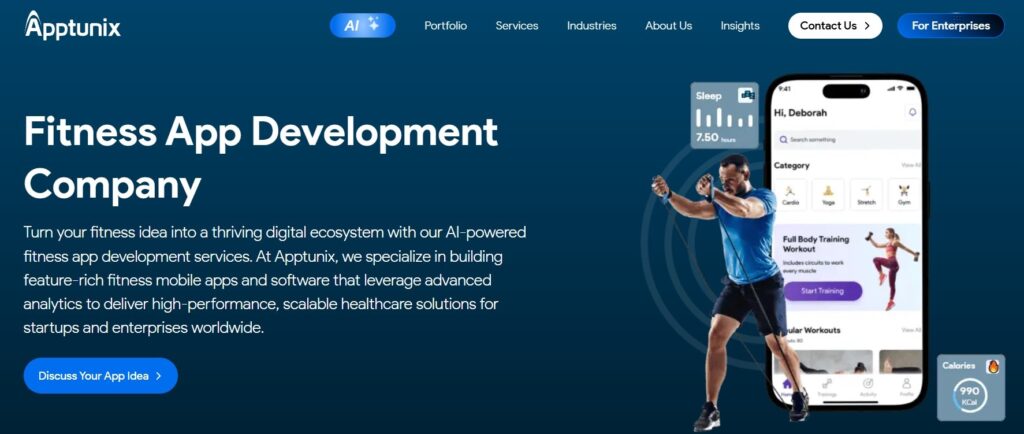
Apptunix has more than 13 years of experience and reports 500+ tech enthusiasts, 2,000+ products delivered, and clients across more than 50 countries. The company also maintains a US office in New York.
Its fitness app development capabilities cover workout applications, nutrition and calorie tracking, sleep and mood tracking, gym management, fitness marketplaces, subscriptions, AI, IoT, gamification, and other advanced features.
This makes Apptunix particularly suitable for businesses looking to create a broader fitness ecosystem rather than a single-purpose workout tracker.
A fitness marketplace, for example, may require users, trainers, gyms, subscriptions, payments, scheduling, reviews, messaging, analytics, and administration. A product engineering company with a broad technology stack can potentially support these interconnected components.
Additional Details
- Company Name: Apptunix
- Website: www.apptunix.com
- Company Size: 500+ Employees
9. BlueLabel
BlueLabel creates custom fitness apps that combine intuitive UX, powerful features, and scalable technology to help brands deliver engaging user experiences.
Company Overview
BlueLabel is headquartered in New York and operates with a distributed team of more than 100 strategists, designers, and developers. The company says it has built more than 350 products across multiple devices and industries.
Its fitness relevance is particularly notable because BlueLabel has publicly discussed digital innovation in fitness and has worked on the JAXJOX connected fitness platform. Its fitness work has included connected equipment, sensor-based experiences, motion capture, real-time feedback, social functionality, and gamification.
The company also has healthcare application development capabilities, including secure healthcare software and healthcare-system integrations.
This combination makes BlueLabel a strong candidate for businesses that want a consumer-friendly fitness experience while also requiring sophisticated health, connected-device, or data capabilities.
Additional Details
- Company Name: BlueLabel
- Website: www.bluelabellabs.com
- Company Size: 100+ Employees
10. WillowTree
WillowTree designs and develops fitness apps with seamless UX, smart features, and scalable technology, helping brands create meaningful digital experiences.

Company Overview
WillowTree was founded in Charlottesville, Virginia, in 2008 and grew into a large digital product organization serving major brands. TELUS International announced its acquisition of WillowTree in 2022, when the organization had more than 1,000 employees and 13 global studios. WillowTree has since been rebranded as part of TELUS Digital.
The company’s strength is less about building a basic fitness MVP and more about delivering highly polished, large-scale digital experiences.
For fitness businesses, this can become relevant when the application is part of a larger ecosystem involving mobile applications, websites, customer engagement, personalization, analytics, memberships, content, commerce, or enterprise systems.
Its background in consumer digital products and enterprise technology makes it a potential fit for large fitness brands, gym chains, sports organizations, wellness enterprises, and established businesses planning a high-traffic digital platform.
Additional Details
- Company Name: WillowTree / TELUS Digital
- Website: www.telusdigital.com
- Historical Team Size: 1,000+ Employees
What Makes a Fitness App Development Company Different From a General Mobile App Company?
A fitness application may look simple on the surface, but its backend and integration requirements can become complex.
For example, a basic fitness app might contain:
- Workout videos
- Exercise instructions
- User profiles
- Progress tracking
But a modern fitness platform could also require:
- Wearable synchronization
- Heart-rate data
- GPS tracking
- Sleep information
- AI recommendations
- Real-time analytics
- Subscription billing
- Trainer communication
- Social challenges
- Gamification
- Connected equipment
- Admin dashboards
- Cloud infrastructure
That is why businesses should evaluate a development company based on fitness-product requirements, not just general mobile development experience.
Types of Fitness Apps You Can Build in 2026–27
1. Workout Apps
Workout apps provide exercise libraries, training plans, video content, progress tracking, and personalized routines.
2. Fitness Tracker Apps
These applications focus on steps, calories, distance, workouts, activity, sleep, and other performance metrics.
3. Personal Trainer Apps
These connect users with professional trainers through workout plans, messaging, scheduling, video sessions, and progress tracking.
4. Nutrition Apps
Nutrition applications can include calorie tracking, meal planning, macro tracking, hydration monitoring, and personalized recommendations.
5. AI Fitness Coach Apps
AI can help personalize workouts, provide recommendations, analyze user behavior, and deliver conversational coaching experiences.
6. Gym Management Apps
These combine membership management, scheduling, attendance, payments, trainers, notifications, and customer communication.
7. Wearable Fitness Apps
These applications connect with smartwatches, fitness bands, smart rings, sensors, and other connected devices.
8. Fitness Marketplace Apps
These platforms can connect users with trainers, gyms, classes, nutritionists, coaches, or fitness services.
9. Corporate Wellness Apps
Businesses can use fitness platforms to manage employee challenges, wellness programs, activity tracking, rewards, and engagement.
10. Social Fitness Apps
These combine fitness with community features such as challenges, leaderboards, groups, sharing, messaging, and competitions.
Must-Have Features in a Fitness App
The exact feature set should depend on your business model, but most modern fitness applications can be organized into three layers.
User Features
- Registration and login
- User profile
- Fitness goals
- Workout plans
- Exercise library
- Activity tracking
- Progress tracking
- Calorie tracking
- Notifications
- Subscription management
- Payment integration
Advanced Features
- Wearable synchronization
- AI workout recommendations
- AI nutrition recommendations
- Real-time activity tracking
- GPS tracking
- Gamification
- Challenges
- Leaderboards
- Social sharing
- Live classes
- Trainer communication
- Voice-based coaching
Admin Features
- User management
- Trainer management
- Workout management
- Content management
- Payment management
- Subscription management
- Analytics
- Reports
- Push notifications
- Role-based access
- Customer support
AI Features That Can Make a Fitness App Smarter
AI is becoming an important part of fitness products, but adding an AI chatbot alone does not make an application intelligent.
Useful AI applications can include:
- Personalized Workout Recommendations
The application can use user goals, activity history, preferences, and progress to recommend suitable workouts.
- AI Nutrition Assistance
AI can help users interpret food information, understand nutritional goals, or receive personalized recommendations.
- Conversational Coaching
Users can interact with an AI assistant to ask fitness-related questions and receive context-based guidance.
- Exercise Form Analysis
Computer vision can potentially analyze movements and provide feedback on exercise form.
- Behavioral Analytics
AI can identify engagement patterns and help businesses understand when users are likely to stop using an application.
- Personalized Notifications
Instead of sending identical reminders to every user, notification strategies can be adapted based on behavior.
- Progress Insights
AI can convert activity data into understandable summaries and recommendations.
The strongest fitness applications will use AI to solve specific user problems, rather than adding AI simply because it is a current technology trend.
Wearable and Health-Data Integrations
Wearable integration is one of the areas where fitness app development becomes technically demanding.
Depending on the product, integrations can include:
- Apple Health
- HealthKit
- Apple Watch
- Google health platforms
- Fitbit
- Garmin
- Smart rings
- Bluetooth/BLE devices
- Heart-rate sensors
- GPS devices
- Connected fitness equipment
The challenge is not simply collecting the data.
The application must determine:
- Which data should be collected?
- How often should it synchronize?
- How should duplicate records be handled?
- What happens when a device disconnects?
- How should background synchronization work?
- How is user consent handled?
- How is the information secured?
- How is raw data converted into useful insights?
This is why wearable and health-data architecture should be considered during the planning stage.
How Much Does It Cost to Build a Fitness App in USA in 2026–27?
Fitness app development cost depends on product complexity.
| Fitness App Type | Approximate Complexity | Planning Budget |
| Basic workout MVP | Low | $25,000–$50,000 |
| Standard fitness app | Medium | $50,000–$100,000 |
| Advanced fitness platform | High | $100,000–$200,000+ |
| AI + wearable fitness app | Very High | $150,000–$300,000+ |
| Enterprise fitness ecosystem | Very High | $250,000+ |
These are planning ranges, not fixed market quotations. Actual cost depends on features, platforms, development team, integrations, AI requirements, UI/UX, backend complexity, security, and post-launch requirements.
For comparison, Zco publicly states approximate development ranges of $40,000 for basic applications, around $100,000 for medium-complexity apps, and $200,000+ for complex applications. TechAhead also publishes separate fitness development estimates based on MVP and medium-scale complexity.
Major Factors That Increase Development Cost
Wearable integrations: Different devices and platforms require additional integration and testing.
AI: Recommendation systems, computer vision, predictive models, and data pipelines add engineering complexity.
Real-time tracking: Live activity, GPS, sensor, and synchronization features require more sophisticated backend infrastructure.
Multiple platforms: Separate native applications can increase development effort compared with a cross-platform strategy.
Enterprise features: Advanced analytics, security, integrations, permissions, and scalability can significantly increase the project scope.
How Long Does It Take to Build a Fitness App?
A typical development roadmap can look like this:
| Development Stage | Estimated Duration |
| Discovery & requirements | 1–3 weeks |
| UI/UX design | 3–6 weeks |
| MVP development | 8–16 weeks |
| Testing & QA | 2–5 weeks |
| Deployment | 1–2 weeks |
| Post-launch improvements | Ongoing |
A basic fitness MVP may take approximately 3–5 months, while an advanced platform with AI, wearable integrations, real-time tracking, and enterprise requirements can take 6–12 months or longer.
The goal should not be to select the company promising the shortest timeline.
Instead, ask:
What can realistically be launched in the first version while keeping the architecture ready for future growth?
What Should a Fitness App MVP Include?
Launching every possible feature at once can increase cost and delay validation.
A phased approach is often more practical.
Phase 1 — Core MVP
- User registration
- User profile
- Fitness goals
- Workout library
- Workout tracking
- Progress dashboard
- Push notifications
- Basic subscriptions
- Admin panel
Phase 2 — Engagement
- Challenges
- Leaderboards
- Gamification
- Social sharing
- Trainer communication
- Advanced analytics
Phase 3 — Intelligence
- AI recommendations
- AI coaching
- Personalized nutrition
- Predictive insights
- Exercise analysis
Phase 4 — Connected Fitness
- Apple Health
- Google health integrations
- Fitbit
- Garmin
- Smartwatches
- BLE devices
- Connected equipment
This approach allows businesses to validate the product before investing heavily in complex technologies.
Custom Fitness App vs White-Label vs Ready-Made Solution
Not every business needs a completely custom application.
| Approach | Flexibility | Speed | Scalability | Suitable For |
| Ready-made | Low | Very Fast | Limited | Basic requirements |
| White-label | Medium | Fast | Medium | Quick branded launch |
| Custom MVP | High | Medium | High | Startups |
| Full Custom | Very High | Medium/Slow | Very High | Growing businesses |
| Enterprise Custom | Maximum | Slow | Maximum | Large organizations |
Choose Custom Development When:
- You have a unique business model.
- You require specialized workflows.
- You need proprietary AI.
- You require wearable integrations.
- You expect substantial user growth.
- You need integrations with existing software.
- You want control over the long-term roadmap.
Fitness App Development Checklist
Before selecting your development partner, check:
- Fitness or wellness development experience
- Relevant mobile app portfolio
- UI/UX expertise
- Backend development capabilities
- API integration experience
- Wearable integration
- AI/ML capabilities
- Real-time data processing
- Security architecture
- Cloud infrastructure
- QA and testing
- App Store and Google Play deployment
- Post-launch support
- Source-code ownership
- Clear pricing
- Development milestones
- Communication process
- Scalability strategy
Final Verdict
Fitness applications in 2026–27 are becoming smarter, more personalized, and more connected than ever. Users now expect fitness apps to do more than simply track workouts. They want personalized recommendations, wearable integration, progress tracking, nutrition support, real-time insights, interactive challenges, and features that fit naturally into their everyday routines.
For businesses, this makes choosing the right fitness app development company an important decision. The development partner you select can have a direct impact on your app’s performance, user experience, security, scalability, and ability to adapt as your business grows.
The best company is not always the one with the largest team or the highest number of reviews. Instead, look for a development partner whose technical expertise, fitness industry experience, development process, pricing model, communication, and post-launch support align with your product goals.
For businesses looking for custom fitness app development, Runtime Logics stands out for its capabilities across mobile development, cross-platform solutions, AI, wearable integrations, APIs, backend development, and ongoing support. Webatlas Tech is another flexible option, offering expertise in mobile applications, AI, cloud solutions, backend systems, and digital product development.
Other companies on this list bring their own strengths. Wildnet Edge focuses on AI-driven and enterprise solutions, while MindSea has strong experience in digital health and user-focused product development. Zco Corporation brings years of software engineering experience, TechAhead combines mobile, AI, and cloud expertise, and Apptunix offers broad product engineering capabilities.
BlueLabel is known for its experience in connected fitness products and user experience, while WillowTree brings extensive experience in enterprise-level digital products and customer experiences.
Before choosing a fitness app development partner, it is important to clearly define what you want to build. Start by answering a few key questions:
- Who is your target audience?
- What problem will your fitness app solve?
- Which features should be included in the MVP?
- Will the app connect with smartwatches or other wearable devices?
- Do you plan to use AI for recommendations or personalization?
- What type of user and fitness data will the app collect?
- How will you monetize the application?
- How do you expect the platform to scale over the next three years?
Once these requirements are clear, comparing the top fitness app development companies in the USA becomes much easier. The right partner should not only help you launch the app but also provide the technology, flexibility, and long-term support needed to keep the product competitive as the fitness app market continues to evolve.
Ready to Build Your Fitness App?
Have an idea for a workout app, fitness tracker, AI fitness coach, gym platform, nutrition application, wellness product, or wearable-connected fitness solution?
Runtime Logics can help you turn that idea into a custom digital product — from discovery and UI/UX to mobile development, backend engineering, API integrations, AI capabilities, wearable connectivity, testing, deployment, and post-launch support.
Your fitness app idea deserves more than a template. Let’s build a product around your users, business model, and growth plans.