
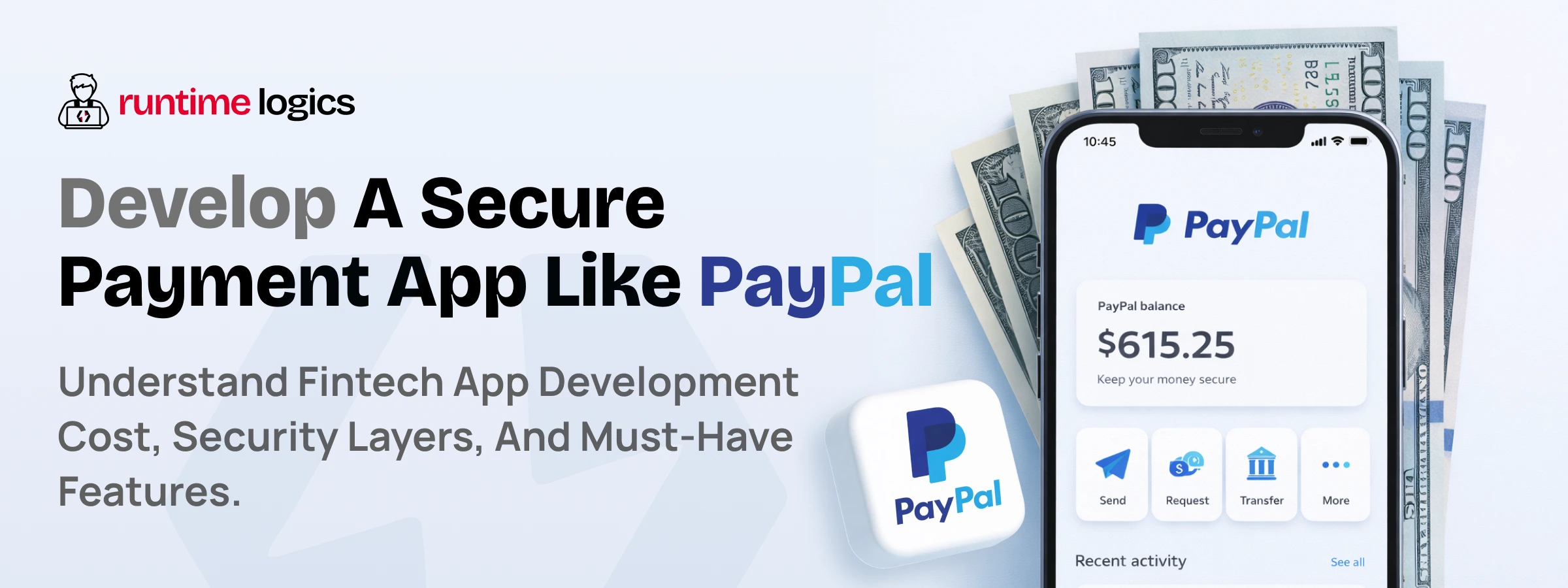
PayPal should be credited for being one of the initial digital payment apps. It is one of the most popular apps in the category to date and is used by not just consumers, but also businesses for global online money transfers.
These are the times when cardless and cashless transactions are trending. The volume of these transactions will grow by the year at a global level. This makes it a lucrative time to go about custom payment app development, which will turn out to be profitable over time. In this article, we discuss how to go about PayPal-like secure payment app development.
How does PayPal make money?
The core revenue streams for PayPal are a percentage of the total payment volume (TPV), cross-border transaction fees, currency conversions, and interest on cash balances. Their primary monetization source is the transaction fees charged to consumers and merchants. When merchants receive a payment, they pay a fee. In the US, the rates for the same are around 2.9% of the transaction value + $0.30.
A higher fee is charged when cross-border transactions are made, because currency conversions are involved. This is often 3-4% above the base exchange rate.
Bank transfers with PayPal are free, but the platform charges a fee of 1.75–2% for instant transfers of funds to debit cards. Then, PayPal earns revenue from value-added services like Buy Now, Pay Later (BNPL). PayPal also generates income from business loan products, crypto transaction fees, and currency exchanges.
Current market value of PayPal
The current market value of PayPal stands between $45 billion and $46 billion. The market capitalization experienced a sharp decline after it peaked at $360 billion in 2021.
The high market capitalization of PayPal primarily stems from their early stages of adoption. They had a crucial partnership with eBay, which lasted from 1999 to 2015. They used to be the preferred payment method at eBay and received 60% of their volume from the eCommerce marketplace. This helped PayPal achieve an instant mass userbase.
After the split with eBay in 2015, PayPal has grown independently. While it has launched new products such as the PayPal Business Debit Card, it has partnered with important tech companies like Alibaba, Facebook, and Google.
PayPal has also made strategic acquisitions through its lifecycle, including Braintree (2013), Venmo (via Braintree), Xoom (2015), and Honey (2020).
Benefits of PayPal like app development
Once you build a digital wallet app development like PayPal, it brings a host of advantages into the picture. This starts with tapping into the digital payments market, which is booming at this time.
Your PayPal clone will ensure instant global transactions. Encryption and biometric technologies will keep these transactions secure. Diverse payment options will not just improve the revenues for your organization but also induce customer loyalty. Users will have the liberty to manage funds, make QR payments, or access transaction history at any time they please. Correspondingly, value-added services, merchant services, and transaction fees will generate more revenue for your organization.
Your app will generate valuable data through transaction logging and in-app messaging, making patterns easy to see and bringing essence to data-based decisions in real time. Your app will be scalable and will scale with your user base.
How you can earn from secure payment app development like PayPal
Once you build a payment app like PayPal, the core revenue streams are going to be transaction fees, premium business subscriptions, interest on held funds, and currency conversions. You’ll charge a fee worth 1.5-3% of transaction value on merchant transactions, while value-added services like instant withdrawal will also be available on your app.
You’ll charge a higher premium for international transfers. While bank-to-bank transfers will be free, your app will charge a fee for instant transfers to bank accounts. Similarly, when a customer makes a payment using a credit card, you’ll charge a higher fee than the bank transfer fee.
Your app will also give out short-term loans to merchants in return for a fee and interest. In-app advertising will be another revenue stream for your platform.
Cost to build custom payment app like PayPal
PayPal-like payment app development costs will typically fall in the range of $30,000 to $150,000+. This is subject to the complexity and features of the app and also to where you choose to get the app developed.
A basic peer-to-peer app shouldn’t cost you over $30,000-$40,000, but it will only have features for simple transactions and digital wallets.
If you go for a slightly more complex app, it will have more features such as a user-friendly interface. Such an app will cost you somewhere in the line of $65,000 to $90,000.
But a high-complexity custom system will be reasonably more expensive, and development charges will stand at $100,000 to $200,000. The features of such an app will include extensive bank integrations, advanced security, and currency exchange.
How to choose a right development partner for a PayPal-like digital wallet app development
To create a custom payment app like PayPal, you need to choose your fintech development partner right. Your digital wallet solution will need to be secure and compliant, built using scalable technologies.
You should prioritize a vendor that brings proven experience in API integrations and PCI-DSS compliance. This can be achieved by verifying their security protocols because a security-first approach is paramount. When working with the vendor, clear communication will be valuable, and they should also provide post-launch support across the long term.
The app needs to be a high performer and shouldn’t crash despite managing numerous high-volume transactions simultaneously. It also needs to be scalable. Your vendor should be capable of creating secure and complex backend systems.
How to build a payment app like PayPal
A secure and robust infrastructure is quintessential when creating a payment app such as PayPal. The focus needs to lie on user authentication, secure wallets, and digital wallet functionality.
To create a PayPal clone, one starts with the MVP and then gets PCI DSS compliance. Integration with bank APIs is the next step, and this is done using a technology stack that includes React Native, Python/Node.js, and secure SQL databases.
Before you go ahead with the development of your app, you need to define the project scope and the functionalities your app will cover. This helps devise a functional roadmap. The associated market research will involve specifying your target audience and analysing competitors.
You should first start with an MVP that will include basic features for user registration, P2P transfers, linking banks or cards, and secure authentication. Since the app is scalable, it will span with your business requirements.
Choosing the right tech stack is important. For cross-platform apps, frontend technologies will be Flutter or React Native. Python or Node.js will be used for the backend. The database used will be MongoDB or PostgreSQL. Similarly, as payment APIs, services like Adyen, Braintree, or Stripe need to be used.
Before launching your app on the Google Play Store and App Store, it needs to be thoroughly tested for all vulnerabilities, which may pertain to biometric authentication or encryption.
* Key features of payment apps like PayPal
1. User-friendly UI/UX
The learning curve for using the app should be low for all users.
2. Support for international transactions
A user should not be required to use multiple apps for transferring money to people in other countries.
3. Invoices and ledgers
When a user is able to comfortably go through his ledger over the app, he can understand his account status easily. This is one of the most important features of a payment app.
4. Instant money transfer
This feature is exceptionally useful when users urgently need to transfer or receive money. PayPal makes this feature available.
5. Security features
Robust security features are non-negotiable for any fintech app.
How Runtime Logics can help you with PayPal-like payment app development
At Runtime Logics, our specialization lies in creating compliant and scalable fintech products. We hold experience across digital wallets, banking, and payments, besides an in-depth knowledge of US regulations and user expectations. Correspondingly, with our services, you can launch quickly and confidently.