
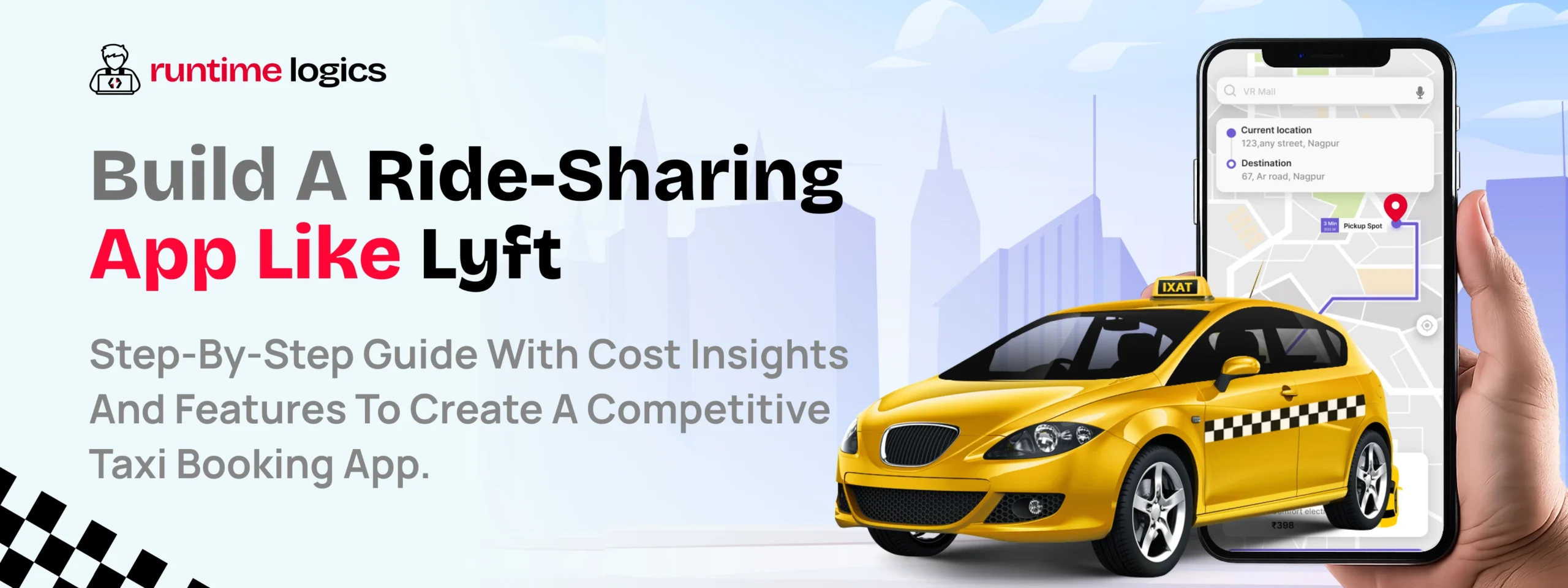
Online taxi booking apps are giving sound competition to the traditional road transportation methods. They create a surer way of booking a cab wherein the wait times involved and the uncertainties associated with the processes are fewer. A few of the users have so much trust in online taxi booking apps that they choose to not own a car at all!
The market for online taxi booking is huge, and the growth potential is tremendous. Online taxi booking is now seen as an essential service by many users, and they rely on these services for their day-to-day work.
Lyft is a major transportation network company operational in the US and Canada. It was founded in 2012 and connects passengers with on-demand rides, motorized scooters, carpooling, and bicycle sharing. In the US, Lyft is the second-largest ridesharing company behind Uber.
How does Lyft make money?
Primarily, Lyft monetizes its platform through the commission model, taking a commission of 20-30% on each ride fare. The other most common monetization model used by Lyft is service and booking fees. While these fees are typically insignificant, they accumulate to a handsome amount when aggregated across millions of rides.
Lyft also earns through surge pricing, which typically sets in during high-demand times. As an example, when a customer books a ride in a busy area, he might have to pay surge pricing fares.
Subscription models such as Lyft Pink are another one of Lyft’s monetization schemes. For a recurring fee, users enjoy perks and discounted rides, making the revenue predictable. Lyft, further, earns revenue through vehicle rentals and partnerships.
Current market value of Lyft
As of April 2026, Lyft has a market cap of $5.28 billion USD. The organization has put in organized efforts to reach a state of profitability. The core focus area in their strategy has been penetrating the North American market. This is a surprising shift from the global trend where companies aim to expand to global markets. Lyft, on the other hand, seeks to create a strong and reliable network in urban areas.
Lyft has also expanded to offer bike and scooter rides. They acquired Motivate in 2018, letting them dominate the bike-sharing market in major US cities. Lyft further made strategic partnerships with autonomous vehicle (AV) companies like Nexar, May Mobility, and Mobileye. Hosting autonomous fleets helps them reduce capital expenditures. As of recently, they have made their advertising revenue high margin.
The most recent profitability strategy of Lyft, put forth in April 2026, includes cost-cutting measures and a $1 billion share repurchase program. These strategies shift Lyft’s focus towards user retention and AI-driven efficiency.
Benefits of Lyft-like app development
When you create a taxi booking app like Lyft, it brings important business benefits into the picture like enhanced brand visibility and high scalability. Your app will let you span new locations. The revenue-generating potential of such an app will be high, primarily in the form of ride commissions and surge pricing.
A Lyft-like app development induces operational efficiency by automated dispatching, cashless payments, and tracking in real time. User experience and retention are hence enhanced via convenience, GPS tracking, and in-app payments. Besides, you will enjoy full control over app development, and it will be 100% customized based on your business requirements.
As a business owner, you can use the tremendous driver and user data to garner data-driven insights. They can be used for service improvement and targeted advertising.

How you can earn from an on-demand taxi app development like Lyft
When you develop an app like Lyft, an on-demand taxi app, its primary source of revenue will be the commissions it charges per ride, which fall in the line of 15-30%. These apps are scalable and grow with your business when you span to other cities. Revenue through commissions increases accordingly.
Similarly, the platforms use algorithms to adjust prices in real time. This makes the business more profitable at the time of high-demand surges.
The other top source of income is subscription fees charged to drivers and riders. Drivers and riders may want to subscribe to the platform for a weekly or monthly subscription. While this ensures no-bounds access to the platform for them, it ensures a predictable source of income for the platform.
Besides, when you build an app like Lyft, cancellation fees, corporate partnerships, and in-app advertising will be its other important sources of revenue. For in-app advertising, the platform sells advertising space to related businesses, such as airlines and hotels.
A taxi booking app may also want to offer premium vehicle options such as luxury and XL for higher fees.
Cost to build a taxi booking app like Lyft
The cost to develop an app like Lyft will typically be within $20,000 and $40,000 if you create the MVP. However, the charges for creating a custom, feature-rich app could be as high as $100,000. If it is a complex enterprise solution that you are looking for, the cost for on-demand taxi app development might breach $300,000. It is noteworthy here that white-label solutions are more affordable, and you could create your app using one for around $10,000.
A basic MVP for an on-demand taxi booking app has features for user registration, basic payment integration, GPS tracking, and simple booking. But, if you create a mid-level app, it will be available for both Android and iOS. Detailed booking options will be available here, and it will have robust payment gateway options and an admin panel.
If you want your app to have features for ride sharing, real-time analytics, AI-driven surge pricing, and loyalty programs, you’ll need to create a full-scale app. Similarly, creating native apps is more expensive than going for cross-platform solutions.
How to choose a right development partner for Lyft clone app development
When finding the right sort of a development partner for Lyft clone app development, it is best to take the services of a vendor that brings along robust experience in creating on-demand apps. Experience working in a ride-hailing ecosystem is equally important.
So, the entrepreneur should go through the prospective vendor’s portfolio and see if they have good experience in transportation and mobility solutions. If they have worked on GPS-based projects, they’ll recognize the complexities associated with route optimization, geolocation, and real-time tracking.
You might prefer a vendor that provides post-launch maintenance, as this will ensure that bugs are fixed in real time and the app keeps operational at all times.
The vendor should deliver a scalable app that grows with your business. They should be knowledgeable about handling matters such as integrating with secure payment gateways, managing data privacy, and compliance with local regulations.

How to create a taxi booking app like Lyft
When you create a taxi booking app similar to Lyft, it will have three core components. They are a passenger app, a driver app, and an admin panel.
Users use the passenger app to sign up and book rides. The app has features to track drivers and make payments. Similarly, a driver will use the driver app to accept trips. It helps him navigate and manage earnings.
The admin panel will act as a control centre to manage drivers, users, and payments. Other important features of the admin panel are managing trip history and promo codes.
To develop a taxi booking app, one starts with the planning and market research phase wherein one finalizes the target audiences and unique value propositions. Finalizing the technology stacks is also important. For cross-platform development, one will use Flutter or React Native. Backend technologies will be Python or Node. js. You may want to use the Google Maps API for geolocation.
The UI/UX of your app needs to be easy to use and intuitive. Similarly, the app needs to be tested thoroughly for scalability, safety, and bugs before it is deployed on app stores.
* Key features of taxi booking apps like Lyft
Real-time tracking is a quintessential feature of taxi-booking apps. This comes through GPS integration, which benefits both drivers and passengers.
Similarly, by using the app, a passenger should be able to make payments through different methods, including digital wallets, cards, and cash. This is achieved through secure payment gateway integration.
While ratings and reviews ensure service quality, an admin should be able to send automated notifications for promotions and booking updates.
How Runtime Logics can help you develop an app like Lyft
If you have recently been considering creating an on-demand taxi booking app, you want to keep it highly engaging to let the app’s performance reach its potential.
Runtime Logics has over the years earned the reputation for being the best taxi booking app Development Company in the USA and India. With our services, you will be able to navigate the market competition, and we will create a winning app for your business.
While being lightweight, your app will have all robust features that your business plan warrants. The app will perform smoothly and glitch-free, and we also provide the best post-launch support.