
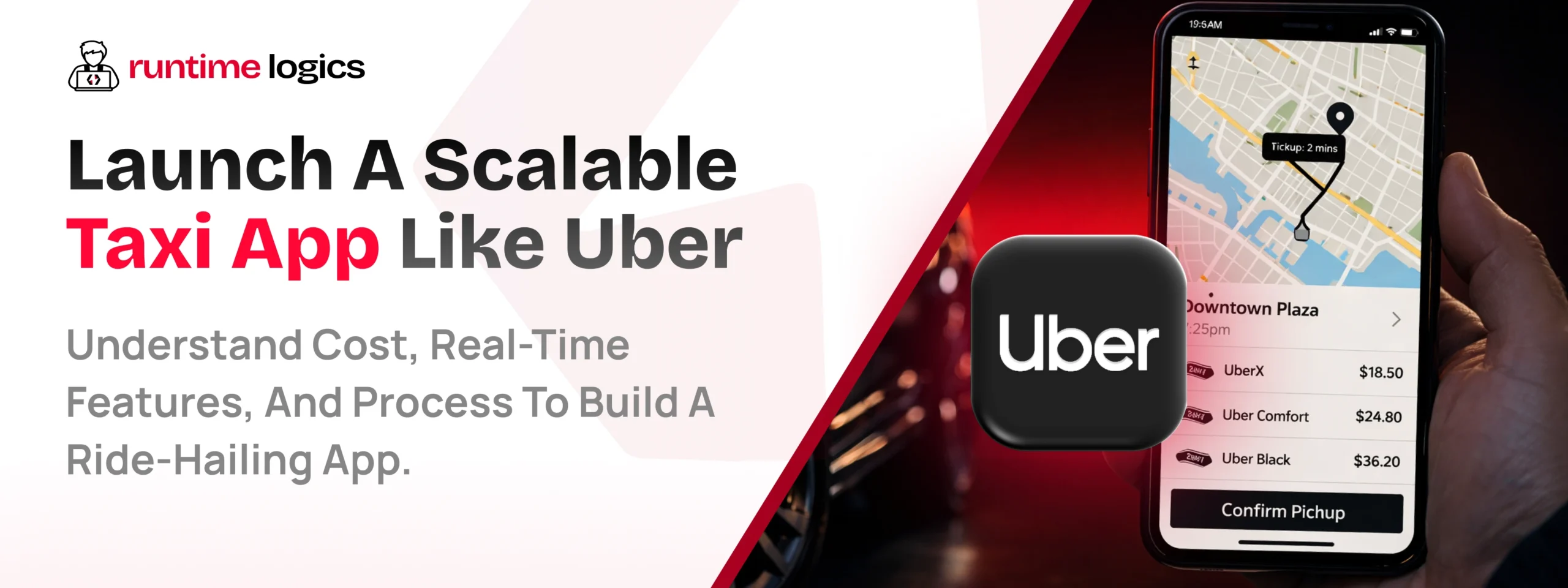
When we take a look at the on-demand apps ecosystem, Uber is one of the first names that come to mind. It is one of the most popular taxi apps through the current times.
The demand for the Uber app is exceptionally high because everyone needs to travel. Uber brings ease to the matter because all you need to do to board a taxi is to book it. The taxi will collect you at your doorstep.
The present-day demand for apps such as Uber is huge because the concept applies to other industries as well. With minor changes here and there, experts create a winning app such as Uber or an Uber clone that perfectly conforms to your market idea.
How does Uber make money?
Uber has diversified sources of revenue that vary across freight, Uber Eats, and ridesharing. As a technology partner, they connect users with freight carriers, food delivery partners, and drivers, charging a commission of 20-30% for each transaction.
The prime source of revenue for Uber, however, is their taxi or mobility services, wherein XL, Uber Black, and UberX are covered. This accounts for 57% of the revenue generated.
Similarly, Uber Eats is a delivery service that charges restaurants on order subtotals and delivery fees from customers. Uber Freight, Uber’s freight platform, connects shippers and shipping carriers. The platform generated USD 5 billion revenue in 2024.
Other top sources of revenue for Uber include their vehicle leasing program for drivers, in-app advertisements, and their subscription programs, Uber One and Uber Pass, that operate on Uber Rides and Uber Eats, respectively.
Current market value of Uber
In early 2025, Uber’s market value surpassed $160 billion. This has to be attributed to their use of disruptive technology. Acting meticulously in their operations, Uber has spanned the globe. What once used to purely be a ride-hailing app has now transformed to become a highly diversified platform for mobility and delivery.
Uber’s business model is best defined as disruptive, as it is a light-asset model and operates as a two-sided marketplace. As of now, Uber is seen as the one-stop resource for providing urban transportation. Similarly, the value of Uber Eats increased manifold during the time of lockdown.
Uber has put in great efforts in increasing its network of drivers. Riders are attracted to the platform because wait times for them are low. This yields the winning edge for the organization.
Another important monetization scheme for Uber is their in-app advertising. A large user base makes advertising on their app lucrative.
Uber is committed to providing a seamless customer experience for its users in the form of consistent services, cashless payments, and live tracking.
Benefits of Uber clone app development
When you develop an app like Uber, it works at several levels. The on-demand market is huge through the current times and features heavy revenue potential. Scalability of apps operating in this niche is also elaborate, and this further brings diversified revenue streams into the picture. The top among them are commission, surge pricing, and advertising. A vendor, alternately, generates income through cancellation fees, partnerships, and premium vehicle options.
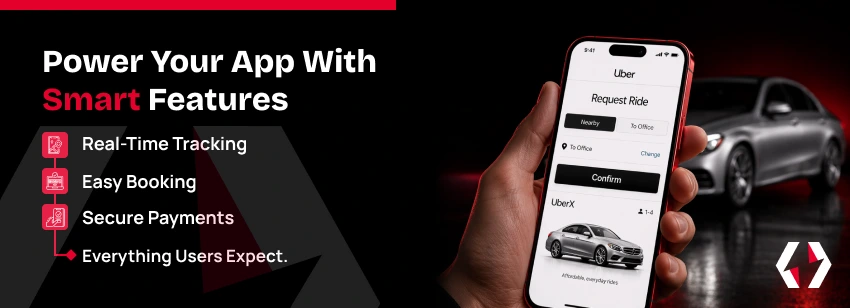
When made meticulously, on-demand taxi app development nurtures and induces customer loyalty by unveiling features such as automatic dispatching, cashless payments, and real-time tracking. This accounts for a transparent user experience wherein a passenger can monitor his ride in real-time and also access in-app support.
Similarly, an app similar to Uber will collect magnanimous amounts of behavioural and operational data, bringing ease to making data-driven decisions.
How you can earn from an on-demand taxi app development like Uber
When you create a taxi booking app like Uber, it will enjoy multiple revenue streams. The most important among them is a commission-based model wherein you can charge 15-30% of fare per ride. Surge pricing during peak hours will deliver additional revenue. A few of the important times when this surge pricing comes into the picture are during traffic jams and overcast conditions.
Among the other most important sources of revenue will be cancellation charges. You might want to charge a driver subscription fees wherein the driver does not pay a commission for each ride but instead pays a weekly or monthly subscription fee. In return, he gets unlimited access to the platform.
Then, you could generate revenue from in-app advertising, as local hospitality businesses like hotels and restaurants will be delighted to advertise on your platform. You could rent out advertising space to them.
Cost to develop a taxi booking app like Uber
The cost to develop an app like Uber will depend on many factors. Many stages are involved in creating such an app, and costing is associated with each phase of development.
When a seasoned software development company creates an Uber clone for your organization, they will recommend going ahead with an MVP first to test its performance. This will be scalable and will easily scale with your business requirements or as your business grows.
The top factors influencing the pricing to create a taxi booking app like Uber include:
- Development team’s experience
- Technologies used
- Hourly or project price rates based on location
- App security features
When you need to develop a taxi booking app like Uber, we offer several engagement models that we can use based on project requirements.
In general, the MVP for an app similar to Uber will cost somewhere between $40,000 and $80,000. The costs will increase significantly if we go for a full-fledged, enterprise-level solution and will come in the line of $300,000. Ultimately, the costs are subject to the features your app needs to have and its security requirements.
How to choose a right development partner for a taxi booking app development like Uber
When looking for Uber clone app development, you want to take the services of a vendor that has demonstrated proven expertise in on-demand app development. Going through their portfolio will deliver an idea about the same. Your development partner should have a fair idea about delivering scalable apps. Their knowledge of Native technologies like Kotlin/Swift and cross-platform technologies like Flutter should be excellent. They should also know about GPS integration and scalable backend technologies.
Ultimately, the priority should lie on companies that offer customized solutions. Strong backend architecture is equally important for tracking in real-time, and so is post-launch support.
How to develop an app like Uber
When we take a look at the steps involved with Uber clone app development, it starts with conducting sound market research wherein we centre down on your target audience. Are we looking for an app in the space of eco-friendly fleets, carpooling, or medical transport?
Next, intuitive prototypes and wireframes are formulated using a tool such as Figma. Now, in the development phase, we start with the backend followed by applications for drivers and riders, which are simultaneously created.
Before delivering the app, it undergoes rigorous testing on quality parameters, such as system stability under load, payment security, and GPS accuracy.
Before the app spans to many cities, the MVP is launched in a single city so feedback can be gathered before expansion.
Key features of taxi booking apps like Uber
The ecosystem of your app, similar to Uber, will have three components: a passenger app, a driver app, and an admin panel. The admin panel will be a web-based dashboard that manages users, verifies drivers, sets prices, and views analytics. A real-time backend will support all the three components.
Each of these three components will be distinct interfaces that will need to be interconnected for the proper functioning of the app.
When developing the app, developing the MVP first is the best practice, as this lets you quickly test your idea before you may want to scale. Top features of an Uber app clone in its MVP stage will be the following:
- Onboarding Features
Basic onboarding features for both drivers and riders made possible by phone, email, or social media. Users will be able to create a profile and register.
- Tracking Cabs
For tracking cabs, you want to use geolocation features via the Mapbox or Google Maps platform.
- Ride Matching Algorithm
A ride matching algorithm will be used to pair a rider with a driver available closest to him.
- Transparent pricing
Transparent pricing will induce customer trust.
- Payment Gateways
Customers will be able to make payments using local wallets or gateways like PayPal.
- Push Notifications
You might want to use Firebase Cloud Messaging to generate push notifications about driver arrival and ride status.
How Runtime Logics can help you develop a taxi booking app like Uber
We start with gathering project requirements wherein we understand your business model and target audiences. Next is the blueprint & design stage that defines the look and feel of your app. We start by creating a wireframe blueprint for each stage.
The development stage involves detailed coding. This is followed by the testing stage wherein all bugs are eliminated. Flawless functioning of your app is assured before its final launch. Finally, we launch your app on the Google Play Store and App Store, and it is ready for download.