
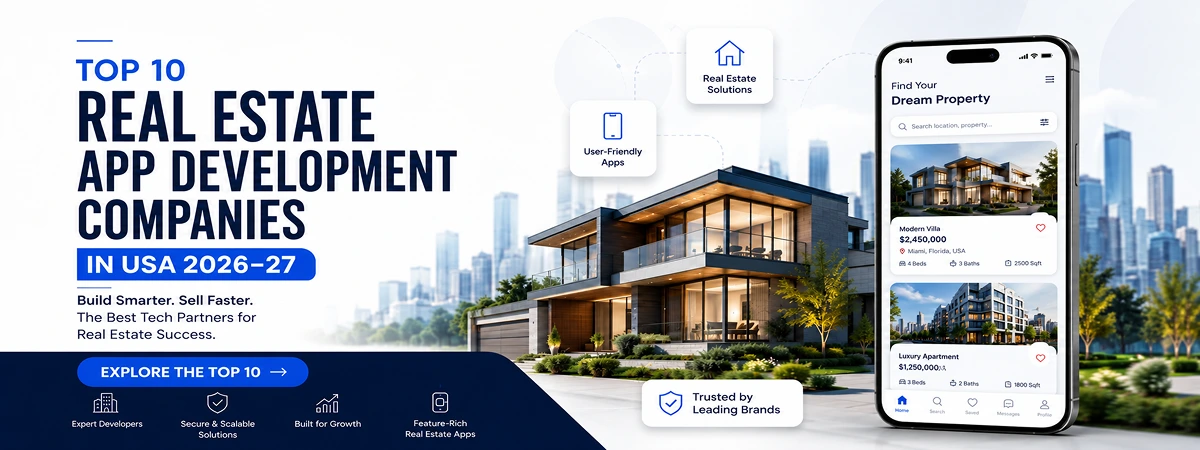
Finding a development partner for a real estate app is about more than comparing company names or hourly rates. A successful property platform needs to handle property discovery, location data, user accounts, agent or broker workflows, lead management, integrations, security, and the ability to scale as listings and users grow.
This guide highlights the top 10 real estate app development companies in the USA for 2026–27, comparing their capabilities, strengths, services, technologies, and suitability for different types of real estate products. The list includes companies that can support projects ranging from property listing and rental apps to real estate marketplaces, property management platforms, and broader PropTech solutions.
To make the comparison more useful for businesses planning a real estate application, we look beyond generic app-development claims and consider factors such as real estate/PropTech relevance, mobile and web development expertise, integration capabilities, technology stack, portfolio evidence, scalability, client reputation, and post-launch support.
Whether you are validating a real estate app idea, modernizing an existing platform, or building a scalable PropTech product, the companies below can help you identify a development partner that fits your project requirements.
Quick Comparison of the Top 10 Real Estate App Development Companies
| Rank | Company | Best For | Key Strength |
| 1 | Runtime Logics | Custom real estate apps, PropTech products & MVPs | End-to-end web, mobile, API and cloud development |
| 2 | Webatlas Tech | Custom mobile and software solutions | Mobile apps, software development and scalable digital products |
| 3 | LITSLINK | Real estate and PropTech platforms | Product engineering, integrations and emerging technologies |
| 4 | iLounge | Businesses seeking established app development expertise | Mobile product development and vendor-focused delivery |
| 5 | Dev Technosys | Real estate applications and enterprise solutions | Mobile, web, AI and integration capabilities |
| 6 | Wildnet Edge | Custom PropTech and real estate solutions | Real estate-focused development and integrations |
| 7 | MindInventory | Real estate applications and digital platforms | AI, mobile, web and real estate technology services |
| 8 | Appinventiv | Large-scale digital products | Mobile, web, enterprise and emerging technologies |
| 9 | Relevant Software | Custom software and complex digital products | Software engineering and product development |
| 10 | Saritasa | Enterprise software and digital transformation | Custom software, mobile and enterprise solutions |
The ranking is an editorial comparison for this article, not an official industry ranking. Company capabilities, pricing and service availability can change, so businesses should verify current details directly with each provider before making a hiring decision.
How We Selected the Top Real Estate App Development Companies
A long list of development agencies does not automatically make a useful ranking. We therefore considered factors that matter when a real estate business is actually evaluating a development partner.
1. Real Estate & PropTech Relevance
We looked for companies with capabilities relevant to real estate products, including property platforms, marketplaces, property management systems, listing applications, CRM-driven solutions, and PropTech products.
2. Mobile & Web Development Expertise
Real estate products increasingly require more than a mobile application. Depending on the business model, a project may need iOS and Android apps, responsive web applications, admin dashboards, agent portals, and backend systems.
3. Integration Capabilities
Real estate applications often depend on third-party data and business systems. We considered capabilities around APIs, maps, payments, CRM systems, property data, and MLS/IDX-related integrations where publicly documented.
4. Technology Capabilities
Modern real estate platforms may require technologies such as Flutter, React Native, React, Node.js, Laravel, cloud infrastructure, AI/ML, analytics and API-driven architectures. We considered the breadth and relevance of each company’s technical capabilities.
5. Portfolio & Project Evidence
A company’s service page can tell you what it offers, but a portfolio or case study provides stronger evidence of what it has delivered. Businesses should therefore verify relevant project examples before signing a contract.
6. Client Reputation
Client reviews, independent profiles, previous project experience and market presence can provide additional signals when comparing development companies. Third-party directories such as Clutch use client feedback, previous work and market presence as part of their evaluation framework.
7. Scalability & Post-Launch Support
A real estate app may start with a limited number of listings and users but eventually need to support much larger volumes. We therefore considered whether companies can support backend development, cloud infrastructure, maintenance, upgrades and long-term product evolution.
8. Transparency
Where information such as pricing, team size, ratings or specific integrations is not publicly verifiable, it should not be presented as a confirmed fact. Businesses should request a current proposal and verify project-specific capabilities directly with the development company.
What This Ranking Means
The purpose of this list is not to suggest that one company is the right choice for every real estate business. A startup building an MVP has very different requirements from a national brokerage, property management company, real estate marketplace, or enterprise PropTech business.
The most suitable development partner depends on your app type, required integrations, budget, timeline, technical complexity, target users, and long-term growth plans.
The detailed company profiles below therefore explain not only what each company offers, but also what type of real estate project each provider may be best suited for.
Top 10 Real Estate App Development Companies in USA 2026–27
1. Runtime Logics
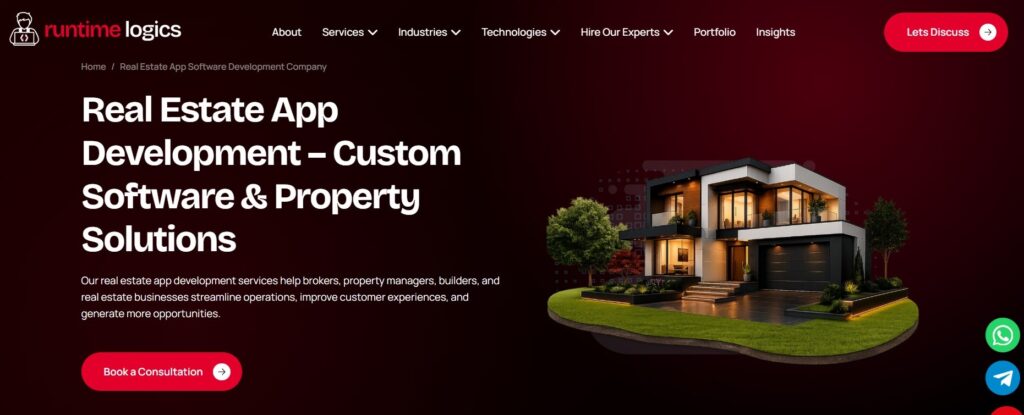
Runtime Logics develops custom real estate apps and PropTech solutions with AI, APIs, cloud, web, and mobile technologies for startups, agencies, and enterprises.
Company Overview
Runtime Logics is a custom software and app development company helping businesses build scalable digital products across web and mobile platforms. Its real estate solutions support applications for buying, selling, leasing, and renting properties, with capabilities for property discovery, management, and AI-powered property search and presentation. The company’s broader technology expertise includes Flutter, React Native, React.js, Node.js, Laravel, Next.js, API development, cloud technologies, and DevOps. Runtime Logics supports projects across the development lifecycle, from requirement analysis and UI/UX design to development, testing, deployment, and post-launch maintenance. Its custom development approach allows real estate businesses to build applications around their specific workflows, user roles, integrations, and business objectives instead of relying solely on off-the-shelf platforms.
Additional Information
- Company Name – Runtime Logics
- Website: www.runtimelogics.com
- Company Size: 10–50 Employees
- Email: info@runtimelogics.com
- Phone: +91 62 62 62 9320
2. Webatlas Tech
Webatlas Tech builds custom real estate mobile and web applications with property search, listings, maps, virtual tours, CRM integration, and scalable software architecture.
Company Overview
Webatlas Tech is a digital product engineering and software development company providing custom web, mobile, AI, cloud, and software solutions. Its real estate development capabilities include property listing platforms, advanced property search, map-based functionality, virtual tours, agent dashboards, CRM integration, and lead management systems. The company also provides broader MVP and custom software development services, making it suitable for businesses validating new PropTech ideas as well as organizations developing larger digital platforms. Its technology capabilities span AI and machine learning, React, Node.js, .NET, cloud technologies, APIs, and full-stack development. Webatlas Tech emphasizes scalable architecture, security, agile collaboration, and long-term product support. The company also maintains a dedicated real estate development article covering property platforms and related application capabilities.
Additional Information
- Company Name – Webatlas Tech
- Website: www.webatlastech.com
- Company Size: 50–100 Employees
- Email: info@webatlas.tech
- Phone: +91 82880 72228
3. LITSLINK
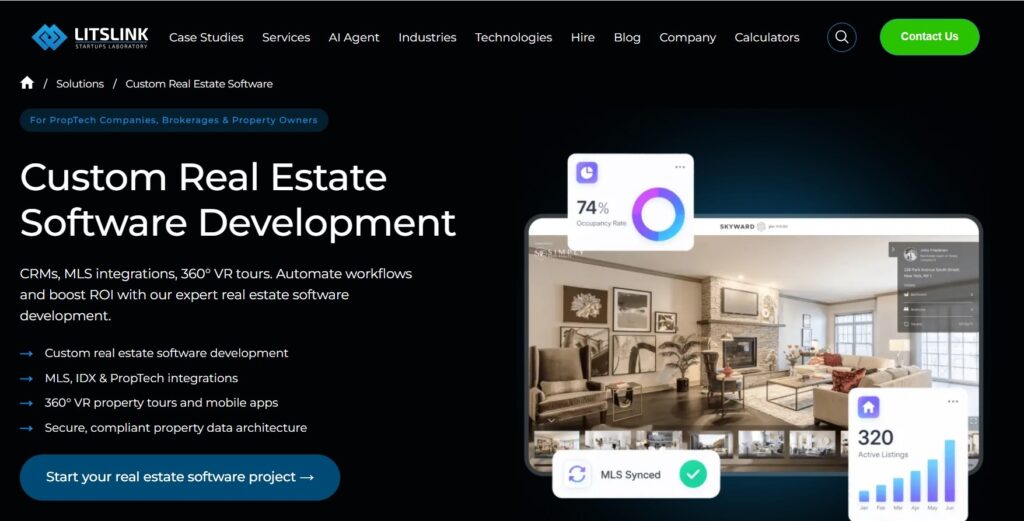
LITSLINK develops custom real estate software, mobile applications, MLS/IDX integrations, analytics platforms, and immersive property experiences for PropTech businesses.
Company Overview
LITSLINK is a US-headquartered custom software development company with dedicated expertise in real estate and PropTech solutions. Its real estate services include custom software development, CRM solutions, MLS and IDX integrations, 360-degree virtual tours, mobile applications, analytics, AI-powered data solutions, and secure property-data architectures. The company also has a documented real estate case study involving a 360-degree virtual tour platform built using Swift, React.js, Unity, WebGL, and Firebase. Its broader development services cover mobile and web applications, AI, AR/VR, SaaS, cloud, and quality assurance. LITSLINK supports different engagement approaches, including fixed-price projects, dedicated teams, and full-cycle outsourcing. Its real estate focus makes it particularly relevant for businesses building data-heavy or technology-driven PropTech products.
Additional Information
- Company Name – LITSLINK
- Website: www.litslink.com
- Company Size: 300+ Employees
4. Vention
Vention develops enterprise-grade PropTech platforms covering property management, AI leasing, smart buildings, resident experiences, IoT, and real estate marketplaces.
Company Overview
Vention is a custom software development company with more than two decades of experience working on real estate and PropTech products. Its real estate capabilities include property management platforms, resident experience applications, AI-powered leasing assistants, smart-building systems, IoT-enabled building operations, and real estate marketplaces. The company states that its engineering teams work with technologies including AI, IoT, machine learning, property-management-system integrations, Salesforce, Stripe, GraphQL, AWS, Kubernetes, Terraform, and real-time analytics. Vention also highlights experience with multi-tenant architectures and security practices aligned with standards and regulations relevant to real estate technology. Its scale and enterprise engineering capabilities make it particularly relevant for organizations building complex, data-intensive, or highly scalable PropTech ecosystems.
Additional Information
- Company Name – Vention
- Website: www.ventionteams.com
- Company Size: 3,000+ Employees
5. TekRevol
TekRevol develops custom real estate applications for property seekers, brokers, builders, and real estate businesses with modern mobile and web technologies.
Company Overview
TekRevol is a Houston-headquartered digital transformation and application development company that started in 2018 as a mobile app development provider and expanded into full-stack software development and technology consulting. Its dedicated real estate offering focuses on applications that connect property seekers with agents, builders, brokers, and other real estate stakeholders. The company describes capabilities around property discovery and marketing, user accounts, property information, communication, and other real estate application functionality. Its broader services cover mobile and web application development, UI/UX design, software development, and digital transformation. TekRevol has a presence across several US locations and has delivered more than 300 projects globally, according to its current company materials.
Additional Information
- Company Name – TekRevol
- Website: www.tekrevol.com
- Company Size: 500+ Employees
6. MindInventory
MindInventory builds real estate marketplaces, property management applications, AI-powered property search platforms, and MLS/IDX-integrated PropTech solutions.
Company Overview
MindInventory is a software development company with a dedicated real estate technology practice covering property marketplaces, brokerage platforms, rental applications, property management systems, investment platforms, and AI-powered property search solutions. Its real estate services include MLS and IDX integration, property data integrations, maps and geolocation, payment gateways, CRM connectivity, virtual tours, analytics, and post-launch application support. The company also highlights real estate projects involving property inquiries, booking platforms, AI, data engineering, and mobile application development. Beyond real estate, MindInventory provides AI/ML, cloud, web, mobile, data, and enterprise software development services. Its combination of real estate-specific capabilities and broader engineering expertise makes it suitable for businesses developing feature-rich property platforms.
Additional Information
- Company Name – MindInventory
- Website: www.mindinventory.com
- Company Size: 300+ Employees
7. Saritasa
Saritasa develops custom real estate software for property listings, CRM, tenant management, virtual tours, smart buildings, analytics, and enterprise property workflows.
Company Overview
Saritasa is a technology solutions company providing custom software development for real estate businesses and property-focused organizations. Its real estate services include custom property platforms, real estate CRM systems, mobile applications for buyers and agents, property management software, client portals, virtual property experiences, analytics, and legacy-system modernization. The company also highlights augmented reality, IoT, smart-building solutions, chatbots, and digital assistants for real estate use cases. Its real estate practice reports 10 years of experience in the niche and 37 successful real estate projects. Saritasa also emphasizes security and compliance considerations involving standards and frameworks such as RESO Web API and Data Dictionary, MISMO, GDPR/CCPA, NIST, and secure development practices.
Additional Information
- Company Name – Saritasa
- Website: www.saritasa.com
- Company Size: 200+ Employees
8. Appinventiv
Appinventiv develops real estate mobile and web applications covering property search, marketplaces, brokerage, property management, AR/VR, AI, analytics, and enterprise solutions.
Company Overview
Appinventiv is a digital engineering company offering mobile, web, enterprise, AI, and software development services across multiple industries, including real estate. Its real estate solutions include property booking platforms, centralized realtor applications, property management systems, apartment-rental applications, home-search solutions, land-for-sale platforms, brokerage applications, and lead-management systems. The company also describes advanced real estate capabilities involving AI/ML, blockchain, AR/VR, IoT, and data analytics. Its technology stack includes Flutter, React Native, Kotlin, Java, Firebase, Figma, and other mobile development technologies. Appinventiv supports projects from planning and market analysis through design, development, testing, deployment, and maintenance. The company began operations in 2015 and currently reports a team of more than 1,600 technology professionals.
Additional Information
- Company Name – Appinventiv
- Website: www.appinventiv.com
- Company Size: 1,600+ Employees
9. Relevant Software
Relevant Software develops custom real estate software and digital platforms with full-cycle engineering, AI, cloud, web, mobile, and dedicated development capabilities.
Company Overview
Relevant Software is a custom software development company founded in 2013 that provides full-cycle engineering and dedicated development services for businesses worldwide. Its real estate practice focuses on helping companies define product requirements, select suitable technologies, build scalable platforms, and support software throughout its lifecycle. The company’s broader capabilities include web and mobile development, AI/ML, cloud solutions, SaaS, IoT, UI/UX, product engineering, and application modernization. Relevant states that it has more than a decade of experience delivering software for the real estate sector and has worked with more than 200 companies overall. Its flexible development approach is designed to accommodate changing product requirements and business priorities, making it an option for companies seeking custom software engineering rather than an off-the-shelf property platform.
Additional Information
- Company Name – Relevant Software
- Website: www.relevant.software
- Company Size: 100–200 Employees
10. Dev Technosys
Dev Technosys provides real estate app and software development services covering property marketplaces, management systems, CRM, AI, analytics, and emerging technologies.
Company Overview
Dev Technosys is a custom software and mobile/web application development company founded in 2010, with a global delivery presence and dedicated real estate industry coverage. Its real estate development services include property listing and marketplace applications, property management and tenant solutions, CRM and broker workflow automation, and AI-powered analytics and emerging technology solutions. The company also works with technologies such as AI/ML, blockchain, IoT, AR/VR, cloud computing, and mobile and web application frameworks. Its current real estate company guide evaluates development providers based on factors including industry experience, client reputation, technical expertise, scalability, and support. Dev Technosys reports serving businesses across multiple countries and maintaining a US office alongside its headquarters in Jaipur, India.
Additional Information
- Company Name – Dev Technosys
- Website: www.devtechnosys.com
- Company Size: 120+ Employees
Real Estate App Development Services & Features You Should Expect
A real estate app can be much more than a digital property directory. Depending on your business model, it can function as a property marketplace, rental platform, property management system, realtor application, investment platform, or complete PropTech ecosystem.
The features you need should therefore be selected according to your users and business workflows rather than copied from another property app.
Types of Real Estate Apps
| App Type | Primary Users | Main Purpose |
| Property Listing App | Buyers, sellers, agents | Property discovery and promotion |
| Real Estate Marketplace | Buyers, sellers, agents | Connect multiple property stakeholders |
| Rental App | Tenants, landlords | Property discovery and rental management |
| Property Management App | Owners, managers, tenants | Manage properties, leases and maintenance |
| Realtor App | Agents, brokers | Listings, leads, clients and appointments |
| Investment App | Investors | Property analysis and investment opportunities |
| Commercial Real Estate App | Businesses, brokers, investors | Commercial property discovery and management |
| PropTech Platform | Real estate enterprises | Automate complex property workflows |
Essential Features
A modern real estate application can include:
- User registration and profiles
- Property listings
- Advanced search and filtering
- Map-based property discovery
- Geolocation
- Property comparison
- Favorites and saved searches
- Property alerts
- Property images and videos
- Virtual tours
- Agent profiles
- In-app messaging
- Appointment scheduling
- Push notifications
- Mortgage calculators
- Payment integration
- CRM integration
- Admin dashboard
- Analytics and reporting
AI-Powered Features
AI can add value when it solves a specific user or business problem.
Useful implementations include:
- AI property recommendations
- Natural-language property search
- AI chatbots
- Automated property descriptions
- AI lead scoring
- Predictive property analytics
- Document information extraction
- Personalized property feeds
The key is to avoid adding AI simply because it is a trend. For example, an AI recommendation engine can be valuable when it improves property discovery, while an AI chatbot can help qualify inquiries and reduce repetitive agent interactions.
Virtual Tours & AR/VR
Real estate apps can also use immersive technologies for:
- 360-degree tours
- Virtual property walkthroughs
- 3D floor plans
- Virtual staging
- AR furniture placement
- Remote property viewing
These features can be particularly useful for luxury, commercial, international, and investment-focused property platforms.
Real Estate APIs, MLS/IDX & Third-Party Integrations
This is one of the areas that can make real estate app development considerably more complex than building a standard marketplace.
A property platform may need to connect with MLS systems, property data providers, maps, CRMs, payment platforms, communication APIs, identity verification services, and property-management software.
MLS & IDX Integration
MLS/IDX integration should not be treated as a universal plug-and-play feature.
The Real Estate Standards Organization (RESO) provides standards for real estate data exchange, including the RESO Web API and Data Dictionary. Access to MLS data itself is controlled by the relevant MLS and is subject to its agreements and data-use requirements.
This means your development team needs to understand both the technical integration and the business/data-access requirements.
RESO Web API
Modern real estate applications may need experience with:
- REST APIs
- JSON
- OAuth
- RESO Web API
- RESO Data Dictionary
- Data synchronization
- Authentication
- Authorization
- Property data mapping
RESO states that its Web API uses RESTful principles, JSON and OAuth-based authentication and authorization.
Other Important Integrations
Maps & Location APIs
Used for:
- Property locations
- Nearby amenities
- Distance calculations
- Neighborhood search
- Location-based recommendations
CRM Integrations
Used for:
- Lead management
- Client profiles
- Sales pipelines
- Automated follow-ups
Payment Integrations
Used for:
- Rent payments
- Deposits
- Subscription payments
- Service charges
Communication APIs
Used for:
- SMS
- Push notifications
- Video calls
Property Management Systems
Used for:
- Tenant information
- Lease records
- Maintenance
- Payments
- Property records
Why Integration Expertise Matters
A development company can be excellent at creating mobile interfaces but still be unsuitable for a complex real estate platform if it lacks experience with data synchronization, APIs, authentication, third-party systems, and real estate data standards.
Before hiring a development partner, ask:
Have you previously integrated MLS/IDX or real estate data systems, and how will data access, licensing and synchronization be handled?
That question can reveal more about a vendor’s actual real estate expertise than simply asking whether they develop real estate apps.
How Much Does It Cost to Build a Real Estate App in the USA?
The cost of developing a real estate application depends heavily on the product’s complexity. A basic property listing MVP and an enterprise PropTech platform can have completely different development budgets.
As a planning range, businesses can consider the following:
| Real Estate App Type | Estimated Development Cost |
| Basic MVP | $30,000–$70,000 |
| Mid-Level Real Estate App | $70,000–$150,000 |
| Advanced Real Estate Platform | $150,000–$250,000+ |
| Enterprise PropTech Platform | $250,000+ |
These are planning estimates, not fixed market prices. Published 2026 estimates from development companies also place real estate application costs across broad ranges depending on functionality, integrations, design, technology, and team composition.
What Determines Real Estate App Development Cost?
1. App Complexity
A basic listing application costs significantly less than a multi-sided marketplace with agents, sellers, buyers, payments and administration.
2. Number of Platforms
Building:
- iOS only
- Android only
- iOS + Android
- Web + mobile
will affect development effort and budget.
3. UI/UX Requirements
Custom user journeys, interactive maps, advanced search, animations and immersive property experiences increase design and development effort.
4. APIs & Integrations
MLS/IDX, CRM, payment, maps, property data, mortgage and communication integrations can significantly affect development cost.
5. AI & Advanced Technologies
AI recommendations, predictive analytics, computer vision, AR/VR and intelligent automation require additional engineering and infrastructure.
6. Backend Architecture
The backend must support property data, users, roles, listings, searches, messaging, notifications, payments and analytics.
7. Security Requirements
Applications dealing with financial information, personal data and property transactions require stronger security controls.
A Better Way to Estimate Your Budget
Instead of asking:
“How much does a real estate app cost?”
Ask:
“What is the minimum product we need to validate the business model, and what should be built after validation?”
That leads naturally to an MVP-first strategy, which can reduce initial development risk.
Real Estate App Development Timeline & Engagement Models
The development timeline depends on the scope, team size, number of platforms, integrations and complexity.
A practical planning framework is:
| Development Stage | Approximate Timeline |
| Discovery & Requirements | 1–3 weeks |
| UI/UX Design | 3–6 weeks |
| MVP Development | 8–16 weeks |
| Advanced Application | 4–8+ months |
| Enterprise Platform | 8–12+ months |
These ranges are indicative. Published 2026 industry estimates also show that real estate applications can take several months, with more complex platforms extending significantly longer.
Common Engagement Models
Fixed Price
Suitable when:
- Scope is clearly defined
- Requirements are stable
- Deliverables are predictable
Time & Materials
Suitable when:
- Requirements may evolve
- You expect continuous product changes
- You are building a long-term platform
Dedicated Development Team
Suitable when:
- You need ongoing development
- Your internal team needs additional engineers
- The product roadmap is expected to grow
For startups, a discovery → MVP → validation → scale approach can often be more practical than trying to build every advanced feature during the first release.
MVP vs Full-Scale Real Estate App: Which Approach Is Right?
Not every real estate business needs a Zillow-sized platform from day one.
Build an MVP If You:
- Are validating a new business idea
- Want to test demand
- Have a limited initial budget
- Need to launch quickly
- Want real user feedback before expanding
Typical Real Estate MVP Features
A first version could include:
- User registration
- Property listings
- Search and filters
- Map integration
- Property details
- Favorites
- Inquiry forms
- Agent contact
- Basic notifications
- Admin dashboard
Once you understand which features users actually use, you can expand the platform.
Build a Full-Scale Platform If You:
- Already have an established customer base
- Operate a large brokerage
- Manage substantial property inventory
- Need complex integrations
- Require multiple user roles
- Need advanced analytics
- Have validated your business model
Advanced features can then include:
- MLS/IDX integration
- AI recommendations
- CRM
- Lead automation
- Payments
- Virtual tours
- Predictive analytics
- Property management
- Advanced reporting
The objective isn’t to launch with the most features. It’s to launch with the right features.
Security, Compliance & Scalability Considerations
Real estate applications can process sensitive personal, financial, property and transaction-related information. Security therefore needs to be considered during architecture and development rather than added immediately before launch.
Important Security Measures
Consider implementing:
- Secure authentication
- Multi-factor authentication
- Role-based access control
- Data encryption
- API security
- Secure payment processing
- Database protection
- Audit logs
- Secure document storage
- Backup and disaster recovery
- Vulnerability testing
- Monitoring and incident response
Compliance Considerations
Depending on the application, market and data being handled, your development team may need to evaluate requirements related to:
- Privacy regulations
- Data protection
- Payment security
- Accessibility
- Real estate data licensing
- MLS rules
- RESO standards
- Regional regulations
For example, Saritasa’s current real estate security documentation references areas including RESO standards, MISMO, GDPR/CCPA, NIST and secure development practices.
Plan for Scalability
Your architecture should be able to accommodate:
- More properties
- More users
- More concurrent searches
- More agents
- More API requests
- More geographic markets
- More data
- Additional features
Cloud infrastructure, caching, database optimization, API management, monitoring and modular architecture can all contribute to long-term scalability.
How to Choose the Right Real Estate App Development Company
The cheapest development quote is rarely enough information to make a good decision.
Before signing a contract, evaluate the company against these areas.
1. Check Real Estate Experience
Ask for actual real estate or PropTech projects rather than a generic mobile app portfolio.
2. Verify Technical Expertise
Make sure the team has experience with the technologies your application actually requires.
3. Ask About MLS/IDX & APIs
If property data is central to your product, ask specifically about previous MLS/IDX, RESO, property-data and third-party API integrations.
4. Review Their Development Process
Understand how they handle:
- Discovery
- UI/UX
- Development
- QA
- Deployment
- Maintenance
5. Clarify Ownership
Before development starts, clarify:
- Source-code ownership
- Intellectual property
- Design ownership
- Repository access
- Third-party licenses
6. Evaluate Security
Ask how the team handles authentication, encryption, API security, access controls, testing and sensitive information.
7. Understand Post-Launch Support
Ask:
- What happens after launch?
- Is maintenance included?
- How are bugs handled?
- How are new features estimated?
- Who handles infrastructure issues?
8. Don’t Compare Companies Only by Hourly Rate
A lower hourly rate does not necessarily mean a lower total cost.
A more experienced team may complete complex integrations faster and reduce rework, technical debt and maintenance problems.
Red Flags to Watch For
Be cautious if a development company:
- Cannot show relevant work
- Promises an unusually low price without requirements analysis
- Guarantees unrealistic timelines
- Avoids discussing security
- Has no clear IP ownership terms
- Cannot explain its integration approach
- Provides no post-launch support
- Uses generic feature lists without understanding your business model
Real Estate App Development Trends for 2026–27
Real estate technology is moving beyond simple property listing and search applications. The strongest opportunities are increasingly centered around automation, personalization, data intelligence and connected property experiences.
- AI-Powered Property Search
Users can increasingly search for properties using natural-language requirements rather than manually applying dozens of filters.
- AI Property Recommendations
Recommendation engines can analyze user preferences, search history and property attributes to surface more relevant listings.
- AI Lead Qualification
AI can help identify high-intent prospects and prioritize leads for agents and sales teams.
- Intelligent Property Analytics
Data-driven platforms can provide insights into property performance, market activity, user behavior and investment opportunities.
- Virtual & Immersive Property Experiences
360-degree tours, 3D environments, AR and VR can help users explore properties without always requiring an initial physical visit.
- Automated Document Processing
AI-powered document extraction can help convert information from leases, property documents and other unstructured sources into structured data. Emerging 2026 research is also exploring LLM-based extraction from heterogeneous real estate documents.
- Connected Smart Buildings
IoT-enabled applications can connect property platforms with:
- Smart locks
- Sensors
- Access control
- Cameras
- Energy systems
- Building management systems
This is particularly relevant for property management and commercial real estate platforms. Vention, for example, currently highlights IoT-enabled building operations and connected smart-property systems as part of its PropTech work.
- Personalization
Real estate apps can increasingly personalize:
- Property recommendations
- Notifications
- Search results
- Content
- Agent matching
- Investment opportunities
The important point is that businesses should adopt these technologies where they improve a measurable part of the property journey, rather than adding technology simply for marketing appeal.
Conclusion
Building a real estate app in 2026–27 requires more than putting property listings into a mobile interface. Whether you’re creating a rental marketplace, realtor platform, property management application, investment solution, or broader PropTech product, the technology needs to support property data, user workflows, integrations, security, scalability, and long-term product growth.
The companies included in this list offer different strengths. Some are better suited to startups and MVP development, while others focus more heavily on enterprise software, PropTech, AI, property management, MLS/IDX integration, or complex digital ecosystems.
Before choosing a development partner, define your app type, target users, must-have features, integration requirements, budget and expected growth. Then compare companies based on relevant experience and technical capability rather than simply selecting the lowest quote.
If you’re planning a custom real estate application, starting with a clear product roadmap and scalable architecture can help you launch faster while leaving room for AI, advanced analytics, integrations and additional features as your business grows.